
What Is Choline?
Choline is a naturally occurring intermediate in the biosynthesis of phosphatidylcholine, a major phospholipid of cell membranes. In laboratory settings it is produced synthetically for ingredient characterization, formulation analysis and neuroscience-related research.
Chemical Identity of Choline
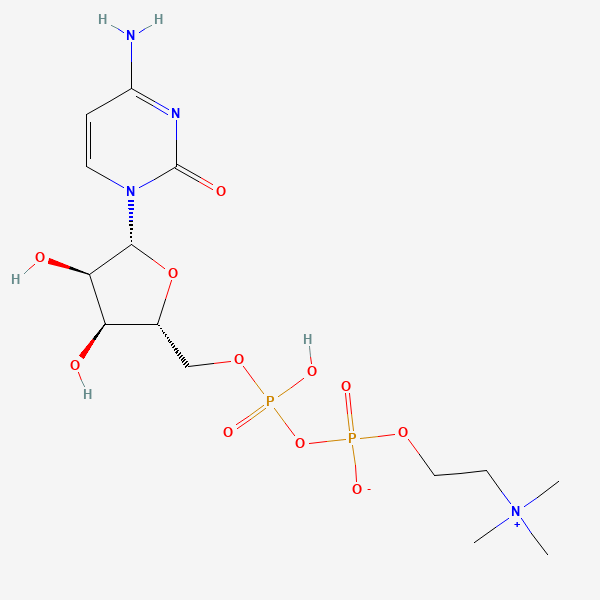
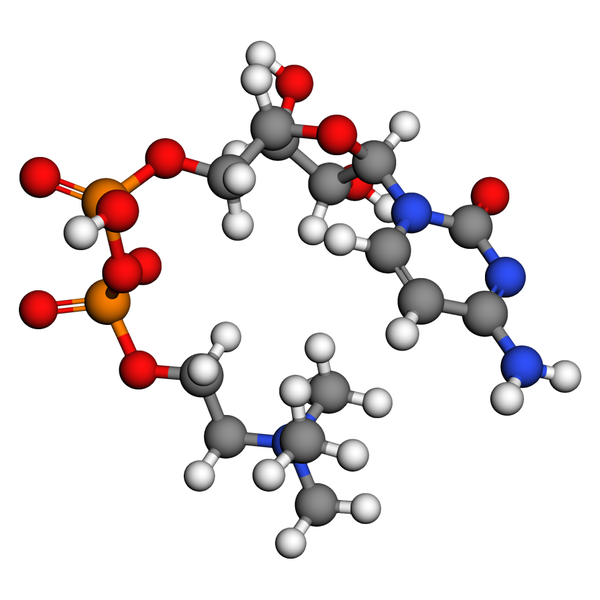
PubChem files Choline under the name Choline, CID 13804, with the formula C14H26N4O11P2 and a molecular weight of 488.32 g/mol. The molecule joins cytidine, a pyrimidine nucleoside, to choline through a diphosphate bridge, which is why it is described as having a cytidine part and a choline part.
Molecular Data
| Property | Value |
|---|---|
| CAS# | 987-78-0 |
| PubChem ID | CID 13804 |
| Molecular Formula | C14H26N4O11P2 |
| Molecular Weight | 488.32 g/mol |
| Exact Mass | 488.1073 Da |
| IUPAC Name | [[(2R,3S,4R,5R)-5-(4-amino-2-oxopyrimidin-1-yl)-3,4-dihydroxyoxolan-2-yl]methoxy-hydroxyphosphoryl] 2-(trimethylazaniumyl)ethyl phosphate |
| InChIKey | RZZPDXZPRHQOCG-OJAKKHQRSA-N |
| SMILES | C[N+](C)(C)CCOP(=O)([O-])OP(=O)(O)OC[C@@H]1[C@H]([C@H]([C@@H](O1)N2C=CC(=NC2=O)N)O)O |
| Molecular Class | Nucleotide-choline conjugate; values are for the parent compound |
| Stereocenters | 4 defined, 0 undefined |
| Hydrogen bond donors / acceptors | 4 / 11 |
| XLogP3 (computed) | -4 |
Values from PubChem CID 13804 (computed by PubChem).
How Choline Works
In metabolic studies, Choline is hydrolyzed into two components: choline and cytidine. Cytidine is subsequently converted into uridine.
- The choline component is studied as a building block for acetylcholine synthesis, similar to other choline-donor research compounds.
- The cytidine-to-uridine pathway is examined in research for its potential role in supporting phosphatidylcholine synthesis, membrane component formation, and brain energy metabolism pathways.
Because Choline contributes to both cholinergic pathways and phospholipid/membrane-related pathways, it is often described in the scientific literature as having a dual mechanism, distinguishing it from simpler choline-donor compounds in comparative research.
Areas of Research Interest
Choline has been examined across a range of research domains in published literature. These findings reflect controlled study data and are not claims about outcomes for any individual.
- Neuroprotection research: A significant portion of the Choline literature focuses on preclinical and clinical research related to ischemic injury models and neuronal membrane repair processes.
- Cognitive research: Studies have examined Choline in relation to attention, memory, and general cognitive performance measures, particularly within older adult study populations and those with vascular cognitive concerns.
- Neurodegenerative disease models: Research has explored Choline in the context of models related to Parkinson’s disease and glaucoma, among other neurological research areas.
- Behavioral research: Preliminary studies, largely in animal models, have investigated Choline in relation to dopaminergic signaling and behavioral research endpoints.
Research Considerations and Safety Signals
Researchers reviewing Choline literature typically note the following considerations:
- Reported observations in human research include mild gastrointestinal effects, headache, and occasional reports of insomnia or restlessness.
- Choline is frequently described in the literature as having a favorable tolerability profile in the study populations examined to date, though research into long-term use continues.
- As with other cholinergic-pathway research compounds, studies combining Choline with other cholinergic or anticholinergic agents take potential interactive effects into account.
These considerations are among the reasons Choline is handled as a controlled research material rather than a general consumer product.
Why Choline Is Used in Laboratory Research
Choline’s dual-pathway profile (contributing to both cholinergic signaling and phospholipid/membrane research) makes it a frequently referenced compound in comparative choline research. Laboratories often study it alongside other choline-donor compounds such as Alpha GPC to evaluate differences in composition, mechanism-related characteristics, and analytical behavior. For a detailed side-by-side look, see our article on Alpha GPC vs. Choline.
Modern Aminos supplies Choline 500MG as a research material manufactured under quality-focused standards for laboratories conducting ingredient evaluation and analytical investigation.
Summary
Choline is a research compound studied for its dual role in cholinergic signaling and phospholipid/membrane-related biosynthesis pathways. It has been explored across neuroprotection research, cognitive research, and neurodegenerative disease models, with researchers also tracking tolerability data reported across study populations. As with all Modern Aminos research materials, Choline is sold strictly for laboratory research purposes.