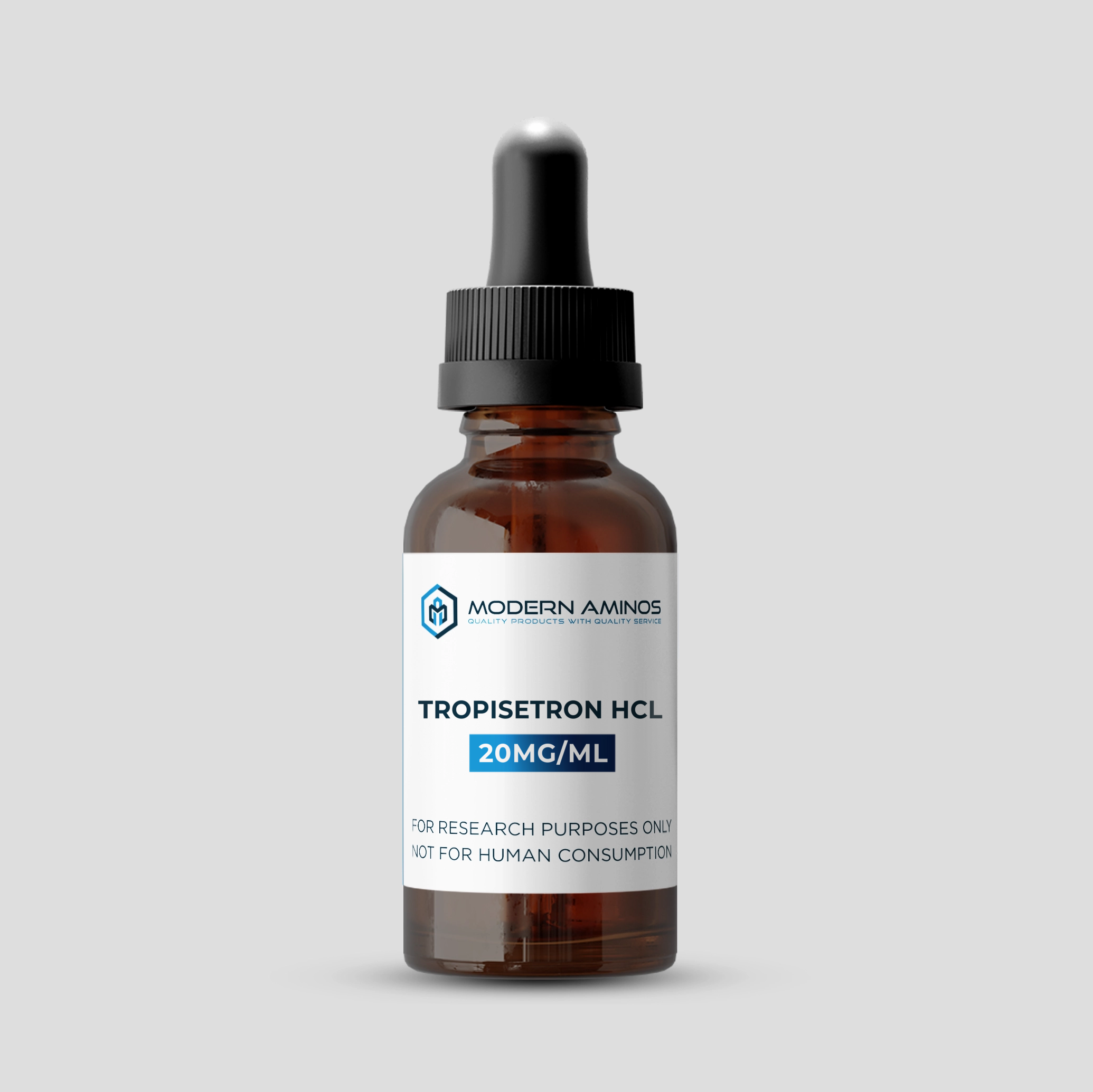
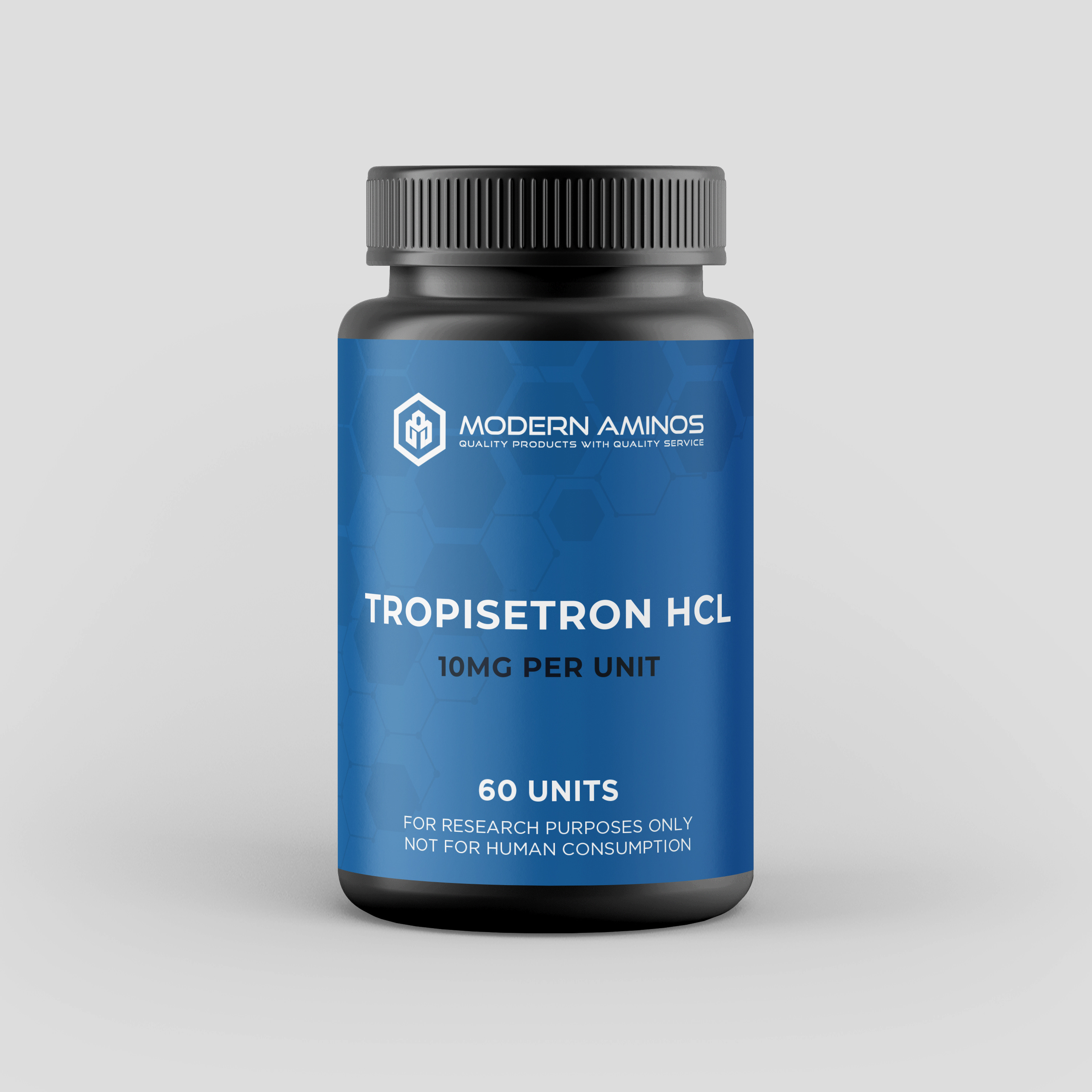
Tropisetron HCl (CAS 105826-92-4; free base CAS 89565-68-4) is an indole-3-carboxylic acid ester of tropine that binds 5-HT3 receptors with sub-nanomolar affinity and acts as a partial agonist at alpha7 nicotinic acetylcholine receptors. Supplied as a 20 mg/mL solution in a 30 mL amber bottle or as 10 mg capsules, 60 per bottle.
Price range: $49.00 through $59.00
Tropisetron HCL (tropisetron hydrochloride, also known by the research code ICS 205-930; CAS 105826-92-4) is the hydrochloride salt of an indole-3-carboxylic acid ester of tropine, formula C17H21ClN2O2 and molecular weight 320.8 g/mol (PubChem CID 656664). The free base, CAS 89565-68-4, is C17H20N2O2 at 284.35 g/mol (PubChem CID 656665).
Tropisetron is a dual-target ligand within the Cys-loop receptor family. It is a high-affinity competitive antagonist at 5-HT3 receptors, with a Ki of 0.72 nM in HEK 293 cell binding (Ruepp et al., 2017, PMC5464333), and a selective partial agonist at alpha7 nicotinic acetylcholine receptors (Macor et al., 2001, PubMed 11212100). That pairing makes it a standard tool for comparing how one ligand behaves at two related pentameric ion channels.
At Modern Aminos, Tropisetron HCL is supplied in 2 laboratory formats:
Laboratories building 5-HT3 and nicotinic receptor panels often place tropisetron next to granisetron and ondansetron, 5-HT3 antagonists that lack its alpha7 activity, and next to tropinone, a stripped-down tropane fragment. For another receptor antagonist explained in depth, see What Is Sipagladenant? KW-6356 Adenosine A2A Antagonist Explained.
| Compound Name | Tropisetron HCL (Tropisetron Hydrochloride) |
|---|---|
| Research Category | 5-HT3 receptor antagonist; alpha7 nicotinic acetylcholine receptor partial agonist; Cys-loop receptor pharmacology reference material |
| Quantity / Formats Offered | 20 mg/mL solution (30 mL amber bottle); 10 mg capsules (60 per bottle) |
| Synonyms / Alt Names | Tropisetron hydrochloride; tropisetron monohydrochloride; ICS 205-930; endo-8-methyl-8-azabicyclo[3.2.1]octan-3-yl 1H-indole-3-carboxylate hydrochloride; 1αH,5αH-tropan-3α-yl indole-3-carboxylate |
| CAS Number | 105826-92-4 (hydrochloride); 89565-68-4 (free base) |
| PubChem CID | 656664 (hydrochloride); 656665 (free base) |
| Chemical Formula | C17H21ClN2O2 (hydrochloride); C17H20N2O2 (free base) |
| Molecular Weight | 320.8 g/mol (hydrochloride); 284.35 g/mol (free base) |
| Exact Mass | 320.1292 Da (hydrochloride); 284.1525 Da (free base) |
| IUPAC Name | [(1R,5S)-8-methyl-8-azabicyclo[3.2.1]octan-3-yl] 1H-indole-3-carboxylate;hydrochloride |
| InChIKey | XIEGSJAEZIGKSA-KOQCZNHOSA-N (hydrochloride); ZNRGQMMCGHDTEI-FUNVUKJBSA-N (free base) |
| SMILES Code | CN1[C@@H]2CC[C@H]1CC(C2)OC(=O)C3=CNC4=CC=CC=C43.Cl |
Identity fields are drawn from PubChem CID 656664 and PubChem CID 656665.
The biochemical targets and pathway logic of tropisetron in laboratory research include:
| Assay Parameter | Value | System | Source |
|---|---|---|---|
| 5-HT3 receptor Ki | 0.72 nM (pKi 9.15) | HEK 293 cells, radioligand binding | Ruepp 2017 |
| Alpha7 nicotinic Ki | 1.58 µM | HEK 293 cells, [3H]epibatidine competition | Ruepp 2017 |
| 5-HT3 vs alpha7 affinity gap | More than 1000-fold | Binding comparison | Ruepp 2017 |
| AChBP co-crystal resolution | 1.75–2.7 Å (series) | Acetylcholine-binding protein | Hibbs 2009 |
| TNF-α / IL-1β release IC50 | 32 µg/mL / 12 µg/mL | LPS-stimulated human monocytes | Fiebich 2004 |
Peer-reviewed literature on tropisetron spans receptor binding, structural biology and human cell signaling:
To map 5-HT3 and nicotinic receptor pharmacology, researchers compare tropisetron against related ligands:
| Compound / Reference | Primary Target Class | Core Mechanism of Action | Research Focus & Profile |
|---|---|---|---|
| Tropisetron HCL | 5-HT3 antagonist; alpha7 nicotinic partial agonist | Orthosteric binding at both Cys-loop receptors | Dual-receptor selectivity, partial agonism structure, cytokine signaling |
| Granisetron | 5-HT3 antagonist | High-affinity orthosteric 5-HT3 binding; no alpha7 binding detected up to 30 µM | Binding-orientation comparator for tropisetron |
| Ondansetron | 5-HT3 antagonist | 5-HT3 antagonism; lacks high alpha7 affinity | Negative control for alpha7 activity |
| Tropinone | Tropane fragment | Alpha7-selective agonist; 100-fold less potent than tropisetron | Pharmacophore dissection of the tropane domain |
Tropisetron HCl is the hydrochloride salt of tropisetron, [(1R,5S)-8-methyl-8-azabicyclo[3.2.1]octan-3-yl] 1H-indole-3-carboxylate. The salt is CAS 105826-92-4, formula C17H21ClN2O2, MW 320.8 g/mol (PubChem CID 656664); the free base is CAS 89565-68-4, C17H20N2O2, MW 284.35 g/mol (CID 656665). The receptor pharmacology is covered in What Is Tropisetron? The 5-HT3 and Alpha7 Receptor Ligand Explained.
Tropisetron joins two parts through an ester bond: an indole-3-carboxylic acid and tropine, the endo alcohol of an 8-methyl-8-azabicyclo[3.2.1]octane (tropane) ring. The tropane nitrogen carries the positive charge at physiological pH, and the indole sits on the other side of the ester.
As a competitive orthosteric antagonist. In radioligand binding on 5-HT3 receptors expressed in HEK 293 cells, tropisetron gave a pKi of 9.15, a Ki of 0.72 nM (Ruepp et al., 2017). 5-HT3 receptors are cation-selective Cys-loop ion channels built from five subunits (Lummis, 2012).
It is a partial agonist. Macor and colleagues identified tropisetron as a potent and selective partial agonist at alpha7 nicotinic receptors, while the related 5-HT3 antagonists ondansetron and LY-278,584 lacked high alpha7 affinity (Macor et al., 2001).
More than 1000-fold. In HEK 293 cell binding, tropisetron had a Ki of 0.72 nM at 5-HT3 receptors and 1.58 µM at alpha7 receptors by [3H]epibatidine competition; an earlier report gave 6.9 nM at alpha7 (Ruepp et al., 2017).
Crystal structures with acetylcholine-binding protein show the protonated tropane nitrogen hydrogen-bonding to the Trp147 backbone carbonyl, while the indole interacts tightly with loop F. That positioning keeps loop C from closing as it does with full agonists (Hibbs et al., 2009).
In LPS-stimulated primary human monocytes, tropisetron reduced TNF-α and IL-1β release (Fiebich et al., 2004) by blocking p38 MAPK activation at a post-transcriptional level (Stratz et al., 2012). In human T cells, it inhibited IL-2 synthesis and NFAT and AP-1 activity, pointing to calcineurin (Vega et al., 2005).
Modern Aminos offers Tropisetron HCL in two formats: a 20 mg/mL solution in a 30 mL amber bottle and 10 mg capsules, 60 per bottle.
All applicable tests are performed on our products, and lot reports are listed on the COA Search page as they are published.
Keep the amber bottle and the capsule bottle tightly closed, upright, and away from direct light, heat and moisture. Follow the label on each lot for any specific storage instructions.
DISCLAIMER: All compounds and research materials provided by Modern Aminos are strictly for laboratory and research use only. They are not approved for human consumption by the Food and Drug Administration (FDA). No products are approved for oral, sublingual, nor in vivo use. These products should not be used for any form of in vivo experimentation or for any other non-laboratory purpose. Any violation or indication of human or animal use will result in immediate removal from being able to purchase products in the future. By purchasing these products, you acknowledge that they will be used exclusively within a controlled and qualified research environment.
