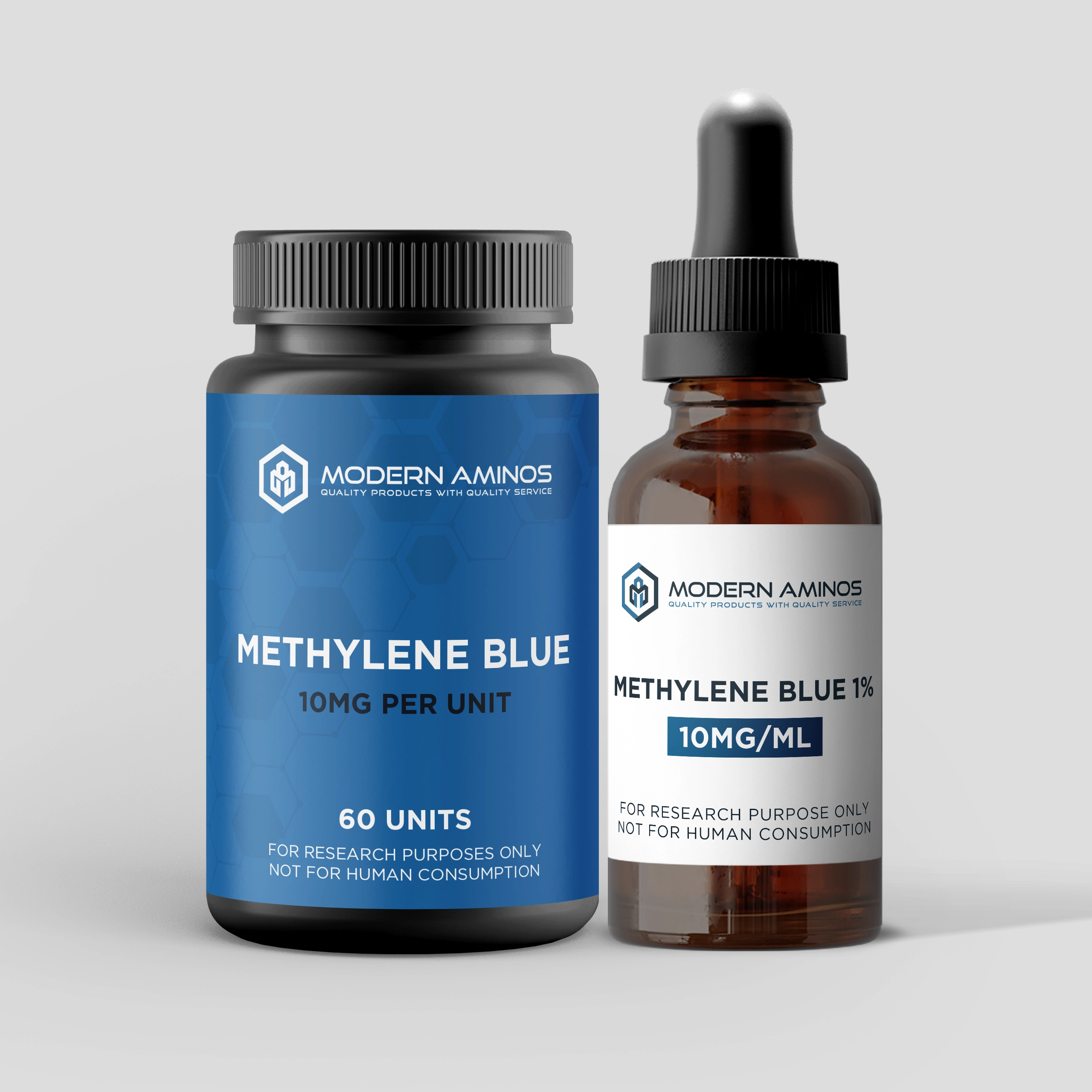
Methylene Blue (Methylthioninium Chloride) is an autoxidizable electron cycler for mitochondrial bioenergetics and cellular respiration research. Operating as an alternative electron donor/acceptor in the mitochondrial electron transport chain (ETC), it bypasses blockade at Complexes I and III, directly reducing cytochrome c to accelerate ATP synthesis and suppress reactive oxygen species (ROS).
Price range: $34.00 through $52.00
Price range: $23.80 through $36.40
| Quantity | Discounted Price |
|---|---|
| 4 - 6 | $32.64 |
| 7 - 9 | $31.96 |
| 10 + | $31.28 |
Methylene Blue (known chemically as Methylthioninium Chloride or 3,7-bis(dimethylamino)phenothiazin-5-ium chloride) is a synthetic phenothiazine derivative and potent redox-active autoxidizable electron cycler. Originally synthesized in 1876 as an aniline dye, it serves as a unique metabolic modifier in cellular biology due to its ability to cycle between oxidized (blue) and reduced leucomethylene blue (colorless) states at low nanomolar concentrations.
Batch-verified for high analytical purity at Modern Aminos, Methylene Blue is offered in three versatile laboratory formats:
Laboratories evaluating mitochondrial electron flux, oxygen consumption rates (OCR), and inducible nitric oxide synthase (iNOS) inhibition utilize Methylene Blue alongside complementary neuro-energetic reference standards available on the site, such as 9-Me-BC, NSI-189 Phosphate, Alpha GPC, and CoQ10.
| Compound Name | Methylene Blue (Methylthioninium Chloride) |
|---|---|
| Quantity / Formats Offered | 10MG/mL Liquid Dropper (30ML) | 5MG Dry-Fill Capsules (60 Count) | 10MG Dry-Fill Capsules (60 Count) |
| Synonyms / Alt Names | Methylthioninium chloride, Swiss blue, Basic Blue 9, Urolene Blue |
| CAS Number | 61-73-4 (Anhydrous) | 7220-79-3 (Trihydrate) |
| Chemical Formula | C16H18ClN3S |
| Molecular Weight | 319.85 g/mol (Anhydrous) | 373.90 g/mol (Trihydrate) |
| IUPAC Name | [7-(dimethylamino)phenothiazin-3-ylidene]-dimethylazanium; chloride |
| InChIKey | YAFRGMALAMOOHI-UHFFFAOYSA-M |
| SMILES Code | CN(C)C1=CC2=C(C=C1)N=C3C=CC(=[N+](C)C)C=C3S2.[Cl-] |
The biochemical pathways and cellular targets:
When evaluating research efficacy and published scientific literature:
To evaluate electron transport mechanisms, bioenergetic pathways, and cellular protection, researchers compare Methylene Blue against alternative reference standards available at Modern Aminos:
| Compound / Reference | Primary Target / Class | Core Mechanism of Action | Research Focus & Profile |
|---|---|---|---|
| Methylene Blue | Phenothiazine Autoxidizable Electron Cycler | Bypasses Complex I/III to transfer electrons to cytochrome c, boosting Complex IV activity and ATP yield | Focuses on mitochondrial electron transport, ROS leakage reduction, Cytochrome c Oxidase kinetics, and iNOS/sGC inhibition |
| 9-Me-BC | Methylated β-Carboline Dopaminergic Agent | Upregulates Tyrosine Hydroxylase (TH) gene expression, drives neurite outgrowth, and boosts Complex I activity | Focuses on structural restoration of dopaminergic neurons, neurite arborization, and catecholamine pathway recovery |
| NSI-189 Phosphate | Benzylpiperazine Aminopyridine Neurogenic Compound | Stimulates neurogenesis and synaptic expansion in the hippocampal subgranular zone (SGZ) | Focuses on hippocampal volume recovery and dentate gyrus neurogenesis rather than direct mitochondrial electron cycling |
| CoQ10 (Coenzyme Q10) | Endogenous Benzoquinone Lipid Electron Carrier | Transfers electrons from Complex I and II to Complex III within the lipid bilayer | Focuses on endogenous membrane lipophilic electron transport and lipid peroxidation prevention |
Yes, Modern Aminos is a highly trusted vendor for high-purity research chemicals and reference compounds. Every batch of Methylene Blue undergoes strict third-party analytical testing (including HPLC and UV-Vis Spectrophotometry) to verify high USP grade chemical purity, exact active concentration, and complete absence of heavy metal contaminants (such as arsenic, lead, or zinc).
Methylene Blue functions as an autoxidizable electron cycler. At low nanomolar concentrations, it accepts electrons from reduced NADH and transfers them directly to cytochrome c, bypassing Complex I and III blockades to increase Cytochrome c Oxidase (Complex IV) activity and ATP production.
Standard antioxidant compounds neutralize reactive oxygen species (ROS) stoichiometrically by consuming themselves. Methylene Blue acts catalytically as a repeatable electron shuttle, preventing ROS generation at the source by rerouting electron leakage away from Complex I and III back into the respiratory chain.
Industrial or dye-grade methylene blue frequently contains heavy metals (lead, cadmium, zinc, arsenic) and synthesis contaminants that induce cytotoxicity and interfere with enzyme kinetics. Modern Aminos supplies ultra-pure reference-grade material suitable for sensitive in vitro assays.
Modern Aminos provides Methylene Blue in three standardized formats: a 30ML liquid solution with 1mL precision dropper (10MG/mL), pre-measured 5MG dry-fill solid oral capsules (60 units per bottle), and 10MG dry-fill solid oral capsules (60 units per bottle).
Methylene Blue acts as a direct electron shuttle across the mitochondrial electron transport chain (Complex IV focus), while 9-Me-BC is a methylated β-carboline that upregulates Tyrosine Hydroxylase gene expression and stimulates dopaminergic neurite outgrowth alongside Complex I enhancement.
Methylene Blue inhibits inducible nitric oxide synthase (iNOS) and binds the prosthetic heme group of soluble guanylyl cyclase (sGC). This blocks the conversion of GTP to cGMP, making it a valuable tool for studying inflammatory signaling and vascular smooth muscle tone.
Methylene Blue solutions and capsule containers should be stored tightly sealed in amber glass containers at room temperature (15°C to 25°C). Protecting the compound from direct sunlight and UV radiation prevents premature photochemical reduction and preserves chemical stability over extended shelf lives.
Disclaimer: All compounds and research materials provided by Modern Aminos are strictly for laboratory and research professional use only. They are not approved for human or animal use nor consumption by the Food and Drug Administration (FDA). These products should not be used for any form of in vivo experimentation or for any other non-laboratory purpose. Any violation or indication of human or animal use will result in immediate removal from being able to purchase products in the future. By purchasing these products, you acknowledge that they will be used exclusively within a controlled and qualified research environment.
The products offered by Modern Aminos are intended strictly for laboratory research purposes only and are sold exclusively to qualified professionals, institutions, and entities. These products are not for human consumption, veterinary use, or any other application involving living organisms, including but not limited to diagnostic, therapeutic, or recreational purposes.
By purchasing this product, you confirm that:
Modern Aminos does not claim that this product is approved by the U.S. Food and Drug Administration (FDA) for any purpose. The statements regarding this product have not been evaluated by the FDA. This product is not intended to diagnose, treat, cure, or prevent any disease.
The buyer assumes full responsibility for ensuring the safe handling, storage, and use of this product. Modern Aminos is not liable for any damages, direct or indirect, resulting from improper handling, storage, or unauthorized use of this product. Furthermore, Modern Aminos reserves the right to refuse sales to any individual or entity suspected of misusing its products.
If you have questions about the safe and lawful use of this product, consult a qualified professional with expertise in laboratory research. By proceeding with this purchase, you agree to these terms and conditions.
