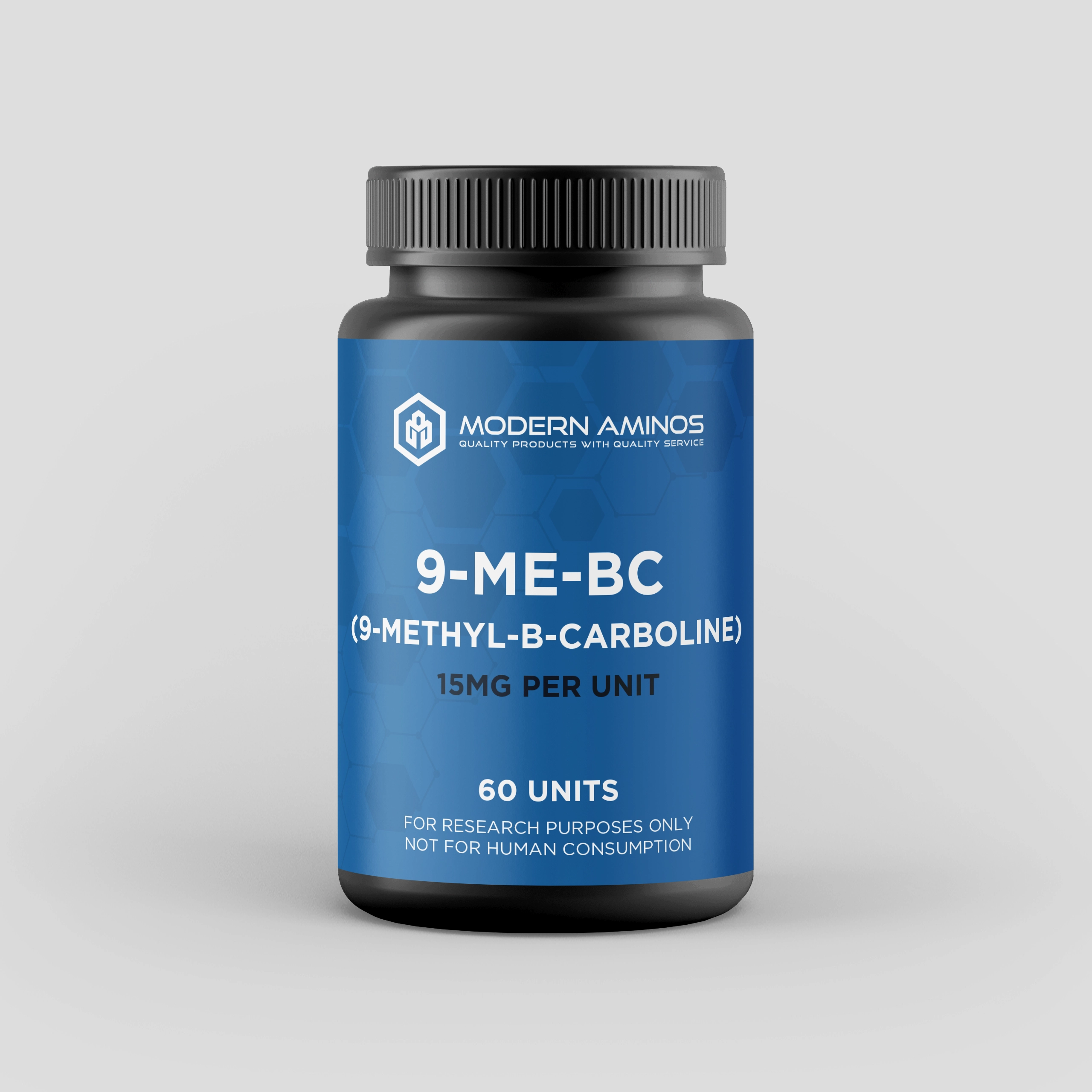
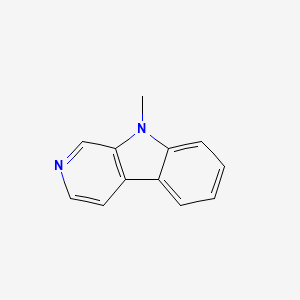
9-Me-BC (9-Methyl-β-Carboline / 9-methylnorharmane) is an N9-methylated β-carboline and monoamine oxidase (MAO) inhibitor reference compound for dopaminergic-pathway and β-carboline structure-activity research. In enzyme assays, 9-Me-BC inhibits MAO-A (IC50 1 µM) at lower concentrations than MAO-B (IC50 15.5 µM), slowing the oxidative deamination of monoamines such as dopamine. CAS 2521-07-5.
$64.00
In stock



9-Me-BC (9-methyl-β-carboline, also called 9-methylnorharmane, N-methylnorharmane, and 9-methyl-9H-pyrido[3,4-b]indole; CAS 2521-07-5) is a synthetic N-methylated β-carboline, a flat tricyclic aromatic heterocycle in which an indole ring is fused to a pyridine ring. It is a monoamine oxidase (MAO) inhibitor reference compound that inhibits MAO-A at lower concentrations than MAO-B. 9-Me-BC is not a peptide and not an amino acid, even though some searches call it a “9-Me-BC peptide.” Its activity in the published literature comes from the aromatic β-carboline ring system, with the methyl group on the indole nitrogen (N9) and the pyridine nitrogen (N2) left free.
In a luminescent MAO-Glo enzyme assay, 9-Me-BC inhibited MAO-A with an IC50 of 1 µM and MAO-B with an IC50 of 15.5 µM (Keller et al., 2020, PMC8592951). In a separate mitochondrial assay, 9-methylnorharman inhibited MAO-B-mediated oxidation of the reference substrate MPTP with an IC50 of 7.3 µM (Herraiz and Guillén, 2011). That is what 9-Me-BC does at the enzyme level: it slows the flavoenzymes that catalyze the oxidative deamination of biogenic amines, including dopamine.
Batch-verified for high analytical purity at Modern Aminos, 9-Me-BC is supplied in one laboratory format:
Laboratories building dopaminergic-pathway and monoamine-enzyme assay panels often place 9-Me-BC next to other public reference listings such as Bromantane, L-THP, NSI-189 Phosphate, and PRL-8-53. For a closer look at whether 9-Me-BC is a peptide, see Is 9-Me-BC a Peptide? 9-Methyl-β-Carboline Explained.
| Compound Name | 9-Me-BC (9-Methyl-β-Carboline) |
|---|---|
| Research Category | Monoamine oxidase (MAO-A / MAO-B) inhibitor; N9-methylated β-carboline (pyrido[3,4-b]indole) heterocycle; dopaminergic-pathway and β-carboline structure-activity reference compound |
| Quantity / Formats Offered | 15 mg Dry-Fill Capsules (60 units per capsule bottle) |
| Synonyms / Alt Names | 9-Methyl-β-carboline; 9-methyl-9H-pyrido[3,4-b]indole; 9-methylpyrido[3,4-b]indole; 9-Methylnorharmane; 9-methylnorharman; N-Methylnorharmane; 9-methyl-9H-β-carboline; 9-Me-BC; 9MeBC |
| CAS Number | 2521-07-5 |
| PubChem CID | 164979 |
| UNII | GC837J2CCJ |
| EPA DSSTox Substance ID | DTXSID50179871 |
| Chemical Formula | C12H10N2 |
| Molecular Weight | 182.22 g/mol |
| Exact Mass | 182.08440 Da |
| Stereochemistry | Achiral; no defined or undefined stereocenters (planar tricyclic aromatic ring system) |
| Computed Properties (PubChem) | XLogP3 2.3; TPSA 17.8 Ų; hydrogen-bond donors 0; hydrogen-bond acceptors 1; rotatable bonds 0 |
| IUPAC Name | 9-methylpyrido[3,4-b]indole |
| InChI | InChI=1S/C12H10N2/c1-14-11-5-3-2-4-9(11)10-6-7-13-8-12(10)14/h2-8H,1H3 |
| InChIKey | MABOIYXDALNSES-UHFFFAOYSA-N |
| SMILES Code | CN1C2=CC=CC=C2C3=C1C=NC=C3 |
Identity fields are drawn from PubChem CID 164979; quantity values come from the certificate in the Certificate of Analysis tab.
The biochemical targets and pathway logic of 9-Me-BC in laboratory research include:
| Assay Parameter | 9-Me-BC | Norharmane (9H-β-carboline) | Source |
|---|---|---|---|
| IC50, MAO-A (MAO-Glo luminescent assay) | 1 µM | not reported in this source | Keller 2020, Fig. 3c |
| IC50, MAO-B (MAO-Glo luminescent assay) | 15.5 µM | not reported in this source | Keller 2020, Fig. 3d |
| IC50, MAO-B-mediated MPTP oxidation (mitochondrial preparation) | 7.3 µM | 9.9 µM | Herraiz 2011, abstract |
| Ki, MAO-A (competitive, reversible) | not reported | 1.2 ± 0.18 µM | Herraiz 2005, abstract |
| Ki, MAO-B (competitive, reversible) | not reported | 1.12 ± 0.19 µM | Herraiz 2005, abstract |
| PNMT-catalyzed 2N-methylation rate | 21.1 pmol/h per unit PNMT | not reported in this source | Gearhart 2002, abstract |
Peer-reviewed literature on 9-Me-BC (9-Methyl-β-Carboline) and its parent ring norharmane centers on enzyme inhibition, gene-expression profiling, enzymatic N-methylation, and photophysics:
To map monoamine-enzyme and dopaminergic-pathway chemistry, researchers compare 9-Me-BC against its parent β-carboline, its methyl isomer, and other dopamine-pathway reference compounds, including several available at Modern Aminos:
| Compound / Reference | Primary Target Class | Core Mechanism of Action | Research Focus & Profile |
|---|---|---|---|
| 9-Me-BC (9-Methyl-β-Carboline) | N9-methyl β-carboline; MAO-A / MAO-B inhibitor | Inhibits MAO-A (IC50 1 µM) ahead of MAO-B (IC50 15.5 µM); pyridine N2 free for protonation and enzymatic methylation | Monoamine-enzyme and β-carboline structure-activity reference; CAS 2521-07-5 |
| Norharmane (9H-β-carboline) | Unsubstituted β-carboline; MAO-A / MAO-B inhibitor | Competitive, reversible MAO inhibition (Ki 1.2 µM MAO-A, 1.12 µM MAO-B) | Parent ring with an indole N-H; PubChem CID 64961 |
| Harmane (1-methyl-β-carboline) | C1-methyl β-carboline; MAO-A inhibitor | Competitive MAO-A inhibition (Ki 55.54 nM) | Same formula and molecular weight as 9-Me-BC (C12H10N2); PubChem CID 5281404 |
| Bromantane | Adamantane secondary amine / actoprotector class | Reported TH transcriptional upregulation; GABA-transporter expression modulation | Catecholamine-biosynthesis pathway chemistry; CAS 87913-26-6 |
| L-THP | Tetrahydroprotoberberine alkaloid / dopamine receptor antagonist | Occupies dopamine D1, D2 and D3 receptors without activating them | Receptor-level dopaminergic pharmacology; see also What Is L-THP? |
Modern Aminos publishes a third-party certificate from Vanguard Laboratory, an A2LA-accredited lab (certificate #6377.01.01), for 9-Me-BC. The 15 mg/unit capsule report (Lab ID V260513-21 001, reported 5/27/2026) lists HPLC-UV/VIS per-unit quantity results for three sampled capsules. If you want to buy 9-methyl-β-carboline as a documented reference material, the certificate is in the Certificate of Analysis tab.
Neither. 9-Me-BC is a small, flat tricyclic heterocycle, 9-methylpyrido[3,4-b]indole (C12H10N2, 182.22 g/mol, PubChem CID 164979). It has no amino-acid residues and no peptide bonds. Its indole half is the same ring system found in L-Tryptophan, which is one reason β-carbolines are sometimes grouped with amino-acid-derived compounds in search results. The full explanation is in Is 9-Me-BC a Peptide? 9-Methyl-β-Carboline Explained.
9-Me-BC from Modern Aminos is a laboratory research compound with a third-party certificate, not a dietary supplement. Chemically it is an N-methylated β-carboline, and it is classified by its monoamine oxidase pharmacology and its β-carboline chemistry rather than by any nootropic label.
The best-characterized molecular targets are the two monoamine oxidase isoforms. In a luminescent MAO-Glo assay, 9-Me-BC inhibited MAO-A with an IC50 of 1 µM and MAO-B with an IC50 of 15.5 µM (Keller et al., 2020). MAO enzymes are flavin adenine dinucleotide (FAD) flavoenzymes on the outer mitochondrial membrane that catalyze the oxidative deamination of biogenic and xenobiotic amines (Herraiz and Chaparro, 2006).
When MAO is inhibited, less substrate amine is oxidized to its aldehyde and pyridinium-type products in a given time. For MAO-B, 9-methylnorharman inhibited the oxidation of the reference substrate MPTP to its pyridinium species in mitochondrial preparations with an IC50 of 7.3 µM, close to norharman at 9.9 µM (Herraiz and Guillén, 2011). The lower IC50 for MAO-A (1 µM versus 15.5 µM) means MAO-A activity is reduced at lower concentrations in the same assay format (Keller et al., 2020).
The methyl group replaces the indole N-H hydrogen of norharmane. PubChem computes 0 hydrogen-bond donors and a TPSA of 17.8 Ų for 9-Me-BC, compared with 1 donor and 28.7 Ų for norharmane (PubChem CID 64961). The pyridine nitrogen (N2) stays free: it is the protonation site in solution (Sánchez Coronilla et al., 2009) and the site that phenylethanolamine N-methyltransferase methylates to give a 2,9-dimethyl-β-carbolinium cation (Gearhart et al., 2002).
Norharmane (9H-β-carboline, C11H8N2, 168.19 g/mol) is the unsubstituted parent ring. Harmane (1-methyl-β-carboline) carries its methyl group on carbon 1 instead of nitrogen 9, so it has exactly the same formula and molecular weight as 9-Me-BC (C12H10N2, 182.22 g/mol) but a different structure (PubChem CID 5281404). The InChIKey, MABOIYXDALNSES-UHFFFAOYSA-N for 9-Me-BC, is the quickest way to tell the two isomers apart.
PubChem CID 164979 lists 9-Me-BC as 9-methyl-β-carboline, 9-methyl-9H-pyrido[3,4-b]indole, 9-methylnorharmane, N-methylnorharmane, and 9-methyl-9H-β-carboline, with CAS 2521-07-5, UNII GC837J2CCJ, and DSSTox DTXSID50179871. In older photophysics papers it is abbreviated MBC, and in URLs and catalogs the Greek β is often written out as “beta.”
Modern Aminos supplies 9-Me-BC in one format: 15 mg dry-fill capsules, 60 units per capsule bottle. A loose powder or liquid format is not offered for this listing.
The three act at different points in dopamine chemistry. L-THP is a receptor-level tool that occupies dopamine receptors without activating them, Bromantane is linked to transcriptional upregulation of Tyrosine Hydroxylase (TH), and 9-Me-BC acts on the MAO enzymes that oxidize monoamines, with additional literature on TH gene expression. See What Is L-THP? Levo-Tetrahydropalmatine Explained and Is Bromantane a Peptide? N-(4-bromophenyl)adamantan-2-amine Explained for those two compounds.
Every batch of 9-Me-BC undergoes strict third-party analytical testing (including HPLC and Mass Spectrometry) to verify minimum 98%+ purity, correct molecular weight (182.22 g/mol), and complete absence of unreacted synthetic impurities or heavy metals. The current Vanguard Laboratory certificate (A2LA #6377.01.01) published in the Certificate of Analysis tab is an HPLC-UV/VIS per-unit quantity report for the 15 mg capsules. The identity fields on this page (CAS, InChI, InChIKey, SMILES) come from PubChem CID 164979.
Keep the capsule bottle sealed, cool, dry, and away from light. Follow the label on each lot. No storage temperature is printed on the current Vanguard certificate, so none is given here.
DISCLAIMER: All compounds and research materials provided by Modern Aminos are strictly for laboratory and research use only. They are not approved for human consumption by the Food and Drug Administration (FDA). No products are approved for oral, sublingual, nor in vivo use. These products should not be used for any form of in vivo experimentation or for any other non-laboratory purpose. Any violation or indication of human or animal use will result in immediate removal from being able to purchase products in the future. By purchasing these products, you acknowledge that they will be used exclusively within a controlled and qualified research environment.
Capsule products are not intended for time-release and are for transport only.
DISCLAIMER: All compounds and research materials provided by Modern Aminos are strictly for laboratory and research use only. They are not approved for human consumption by the Food and Drug Administration (FDA). No products are approved for oral, sublingual, nor in vivo use. These products should not be used for any form of in vivo experimentation or for any other non-laboratory purpose. Any violation or indication of human or animal use will result in immediate removal from being able to purchase products in the future. By purchasing these products, you acknowledge that they will be used exclusively within a controlled and qualified research environment.
