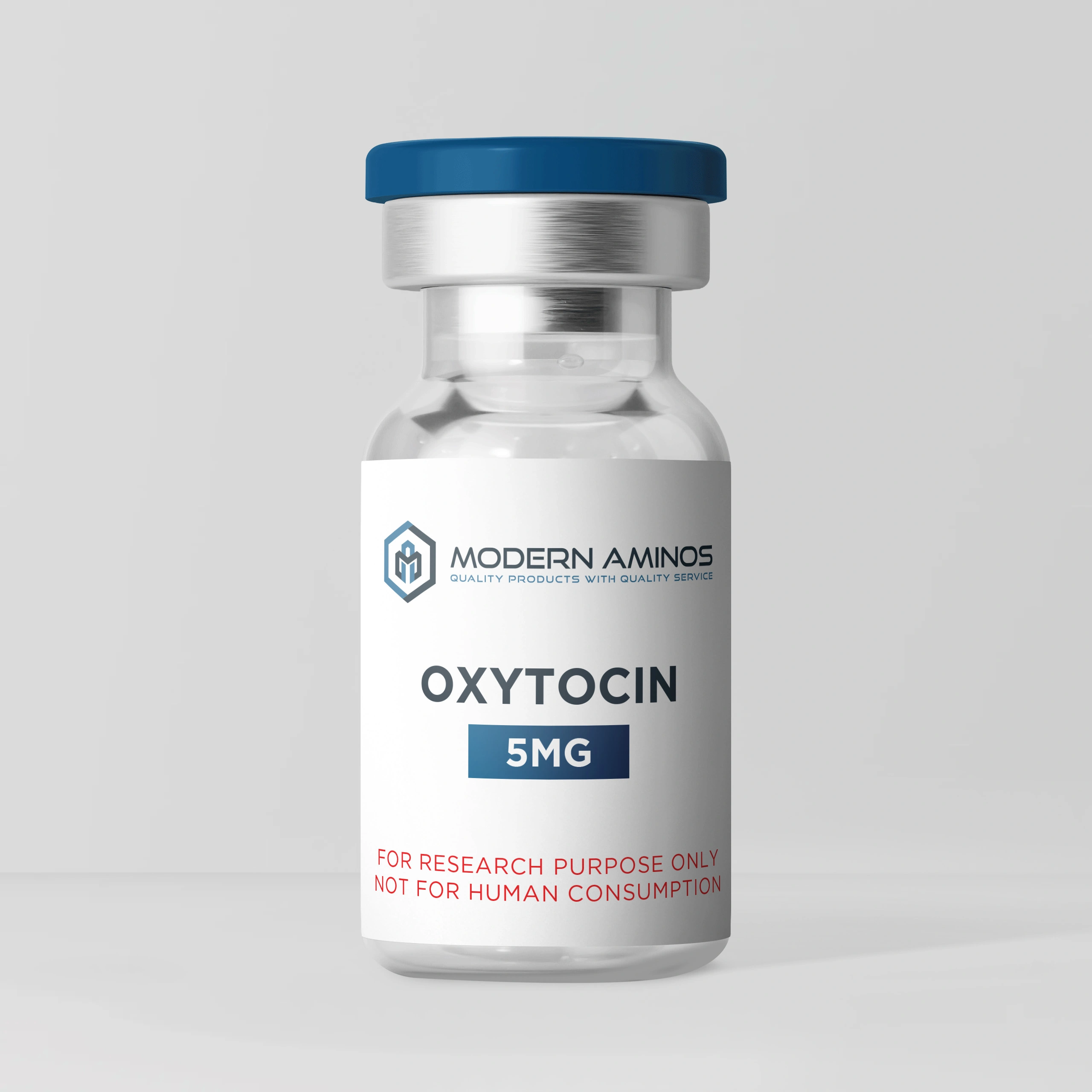
Oxytocin is a synthetic mammalian nonapeptide hormone (Cys-Tyr-Ile-Gln-Asn-Cys-Pro-Leu-Gly-NH2 with a 1-6 disulfide bridge) engineered for neuro-endocrine, smooth muscle contraction, and central neuropeptidergic research. By selectively activating the Gq-coupled Oxytocin Receptor (OXTR), Oxytocin stimulates intracellular calcium mobilization via the Phospholipase C (PLC) pathway.
$29.00
| Quantity | Discounted Price |
|---|---|
| 3 - 5 | $27.84 |
| 7 - 10 | $27.26 |
| 9 + | $26.68 |
Oxytocin is a naturally occurring cyclic nonapeptide neuropeptide synthesized within the paraventricular and supraoptic nuclei of the hypothalamus. Characterized by its conserved nine amino acid sequence (Cys-Tyr-Ile-Gln-Asn-Cys-Pro-Leu-Gly-NH2) with a modern intramolecular disulfide bridge between Cysteine-1 and Cysteine-6, Oxytocin serves as a foundational neuro-endocrine signal across mammalian physiology.
Operating primarily through the G-protein coupled Oxytocin Receptor (OXTR), Oxytocin regulates peripheral myoepithelial and vascular smooth muscle tone while modulating central social affiliation, stress attenuation, and reward pathways in limbic brain structures.
Batch-tested for high analytical purity at Modern Aminos, Oxytocin is offered in a standardized laboratory format:
Laboratories investigating neuro-endocrine receptor kinetics, smooth muscle excitation-contraction coupling, and central behavioral signaling evaluate Oxytocin alongside complementary neuropeptide and melanocortinergic reference standards available on the site, such as PT-141 (Bremelanotide), Melanotan II, and Kisspeptin-10.
| Compound Name | Oxytocin (Hypothalamic Nonapeptide) |
|---|---|
| Quantity / Formats Offered | 5MG Lyophilized Powder (2R Glass Vial) | 10MG Lyophilized Powder (2R Glass Vial) |
| Peptide Sequence | Cys-Tyr-Ile-Gln-Asn-Cys-Pro-Leu-Gly-NH2 (Disulfide Bridge: Cys1–Cys6) |
| Synonyms / Alt Names | Alpha-hypophamine, Pitocin, Oxytocic Hormone, OXT |
| CAS Number | 50-56-6 |
| Chemical Formula | C43H66N12O12S2 |
| Molecular Weight | 1007.19 g/mol |
| IUPAC Name | 1-({(4R,7S,10S,13S,16S,19R)-19-amino-7-(2-amino-2-oxoethyl)-10-(3-amino-3-oxopropyl)-13-[(1S)-1-methylpropyl]-6,9,12,15,18-pentaoxo-1,2-dithia-5,8,11,14,17-pentaazacyclohenicosan-16-yl}carbonyl)-L-prolyl-L-leucylglycinamide |
| InChIKey | XAHKRIXOARWGHG-DMYRUZCASA-N |
| SMILES Code | CCC(C)C1C(=O)NC(C(=O)NC(CSSCC(C(=O)NC(C(=O)N1)CC2=CC=C(C=C2)O)N)C(=O)NC(CCC(=O)N)C(=O)NC(CC(=O)N)C(=O)N3CCCC3C(=O)NC(CC(C)C)C(=O)NCC(=O)N)O |
The biochemical pathways and cellular targets of Oxytocin in laboratory research include:
When evaluating research efficacy and published scientific literature for Oxytocin:
To evaluate receptor selectivity, signal transduction, and physiological targets, researchers compare Oxytocin against alternative neuropeptide reference standards available at Modern Aminos:
While both compounds are investigated for their roles in central nervous system signaling and autonomic neuro-endocrine responses, Oxytocin and PT-141 (Bremelanotide) operate through entirely distinct molecular receptor families:
| Compound / Reference | Chemical Class & Structure | Primary Receptor Target | Research Focus & Profile |
|---|---|---|---|
| Oxytocin | Cyclic Nonapeptide (1–6 Disulfide Bridge) | Oxytocin Receptor (OXTR) [Gq/11-Coupled] | Focuses on intracellular calcium mobilization, smooth muscle contraction, and central oxytocinergic bonding/stress attenuation |
| PT-141 (Bremelanotide) | Synthetic Cyclic Heptapeptide | Melanocortin MC3R & MC4R [Gs-Coupled] | Focuses on central hypothalamic melanocortinergic signaling, adenylate cyclase/cAMP activation, and autonomic arousal pathways |
| Melanotan II | Synthetic Cyclic Lactam Analogue | Non-selective MC1R, MC3R, MC4R, MC5R | Focuses on melanogenesis, skin pigmentation models, and non-selective central melanocortin receptor activation |
| Kisspeptin-10 | Decapeptide Fragment (Kiss-1) | GPR54 (KISS1R) [Gq/11-Coupled] | Focuses on hypothalamic GnRH pulse generation, pituitary gonadotropin (LH/FSH) release, and HPG axis regulation |
Yes, Modern Aminos is a highly trusted vendor for high-purity research chemicals and reference peptides. Every batch of Oxytocin undergoes strict third-party analytical testing (including HPLC and Mass Spectrometry) to verify minimum 98%+ purity, correct disulfide bridge geometry, exact peptide sequence identity, and complete absence of heavy metals or synthesis impurities.
Oxytocin is a cyclic nonapeptide with the primary sequence Cys-Tyr-Ile-Gln-Asn-Cys-Pro-Leu-Gly-NH2. An intramolecular disulfide bond links the cysteine residues at positions 1 and 6, forming a 6-amino-acid cyclic ring with a 3-amino-acid C-terminal tail.
Oxytocin binds Gq-coupled Oxytocin Receptors (OXTR) to trigger intracellular calcium signaling and smooth muscle modulation. PT-141 is a cyclic peptide that targets Gs-coupled central Melanocortin receptors (MC3R/MC4R), activating adenylate cyclase and cAMP pathways in hypothalamic dopamine centers.
Upon binding OXTR, Oxytocin activates Phospholipase C (PLC), which cleaves PIP2 into diacylglycerol (DAG) and inositol 1,4,5-trisphosphate (IP3). IP3 triggers rapid calcium release from the endoplasmic reticulum into the cytoplasm.
Modern Aminos supplies Oxytocin in two standardized glass vial formats: a 5MG lyophilized reference powder vial ($29) and a 10MG lyophilized reference powder vial ($36). Both formats feature sealed rubber stoppers to preserve peptide stability.
The disulfide bridge between Cys1 and Cys6 holds the N-terminal ring in the specific rigid conformation required to fit into the ligand-binding pocket of OXTR. Reduction or cleavage of this disulfide bond completely abolishes receptor binding affinity.
Unopened lyophilized Oxytocin vials should be stored frozen at -20°C for long-term preservation. Protect from direct light, heat, and moisture. Once reconstituted into liquid solution, store refrigerated between 2°C and 8°C and use within designated laboratory testing windows.
Disclaimer: All compounds and research materials provided by Modern Aminos are strictly for laboratory and research professional use only. They are not approved for human or animal use nor consumption by the Food and Drug Administration (FDA). These products should not be used for any form of in vivo experimentation or for any other non-laboratory purpose. Any violation or indication of human or animal use will result in immediate removal from being able to purchase products in the future. By purchasing these products, you acknowledge that they will be used exclusively within a controlled and qualified research environment.
The products offered by Modern Aminos are intended strictly for laboratory research purposes only and are sold exclusively to qualified professionals, institutions, and entities. These products are not for human consumption, veterinary use, or any other application involving living organisms, including but not limited to diagnostic, therapeutic, or recreational purposes.
By purchasing this product, you confirm that:
Modern Aminos does not claim that this product is approved by the U.S. Food and Drug Administration (FDA) for any purpose. The statements regarding this product have not been evaluated by the FDA. This product is not intended to diagnose, treat, cure, or prevent any disease.
The buyer assumes full responsibility for ensuring the safe handling, storage, and use of this product. Modern Aminos is not liable for any damages, direct or indirect, resulting from improper handling, storage, or unauthorized use of this product. Furthermore, Modern Aminos reserves the right to refuse sales to any individual or entity suspected of misusing its products.
If you have questions about the safe and lawful use of this product, consult a qualified professional with expertise in laboratory research. By proceeding with this purchase, you agree to these terms and conditions.
