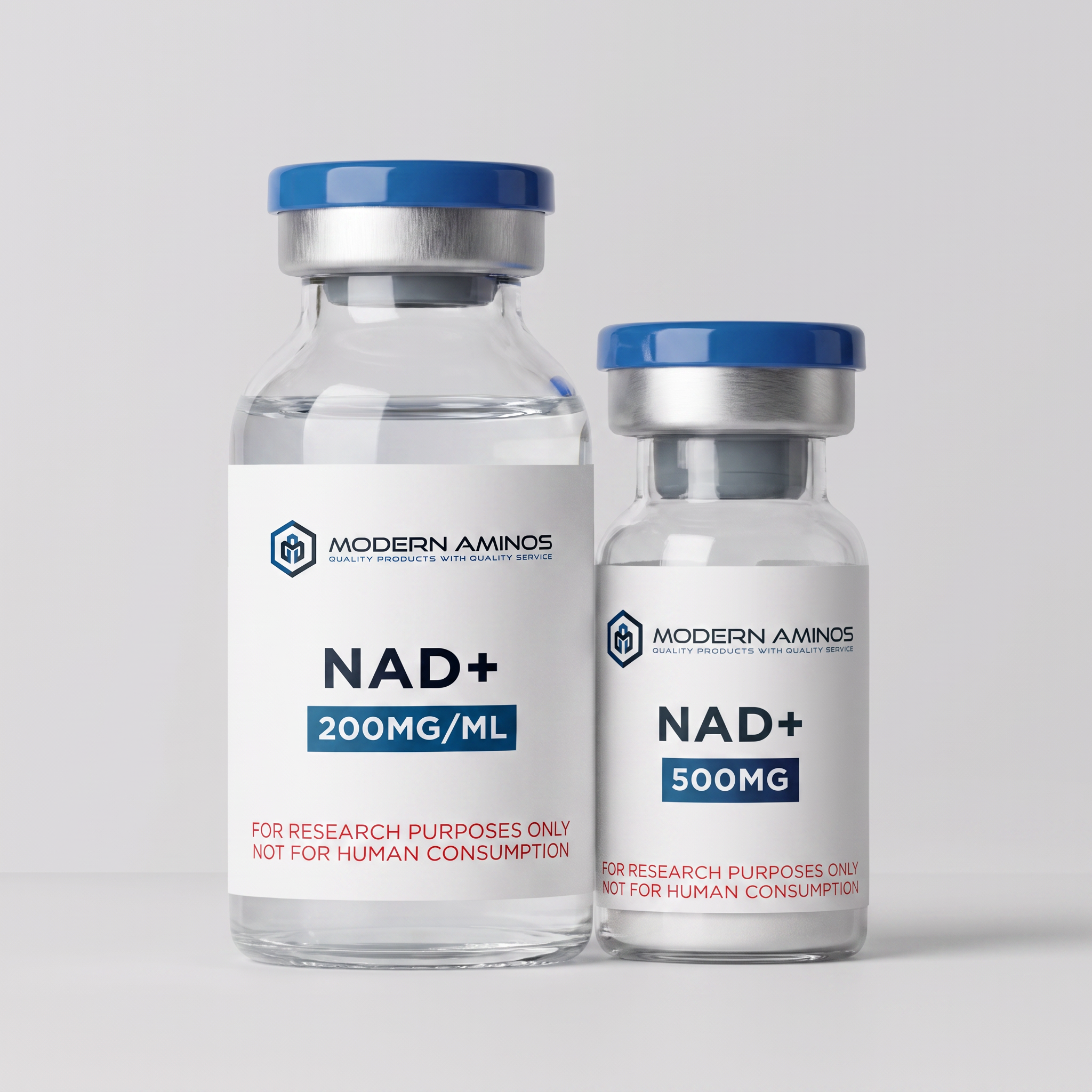
NAD+ (Nicotinamide Adenine Dinucleotide / β-NAD+) is an indispensable pyridine nucleotide coenzyme and regulates cellular redox states. Operating as a critical electron acceptor in glycolysis and the Krebs cycle, NAD+ transfers hydrides to mitochondrial Complex I while serving as an obligate, consumable substrate for sirtuin deacetylases (SIRT1–7), PARP DNA-repair enzymes, and CD38 cyclase signaling cascades.
Price range: $58.00 through $79.00
| Quantity | Discounted Price |
|---|---|
| 4 - 6 | $55.68 |
| 7 - 9 | $54.52 |
| 10 + | $53.36 |
NAD+ (known chemically as Nicotinamide Adenine Dinucleotide, β-NAD+, or DPN) is a fundamental dinucleotide coenzyme found in all cells. Structurally composed of two mononucleotides joined through their phosphate groups—one containing an adenine nucleobase and the other a nicotinamide ring—NAD+ functions as a vital central node connecting cellular bioenergetics with genomic stability and epigenetic signaling.
Operating across two primary cellular modalities, NAD+ acts reversibly as an electron carrier (cycling between oxidized NAD+ and reduced NADH) to power mitochondrial oxidative phosphorylation and ATP generation. Concurrently, it functions as an essential, non-renewable co-substrate for regulatory enzymes, including class III histone deacetylases (Sirtuins, SIRT1–7), poly(ADP-ribose) polymerases (PARPs), and cyclic ADP-ribose synthases (CD38/CD157).
Batch-verified for high analytical purity at Modern Aminos, NAD+ (Nicotinamide Adenine Dinucleotide) is supplied in 2 standards:
Researchers investigating mitochondrial respiratory capacity, sirtuin activation kinetics, and DNA repair mechanics evaluate NAD+ alongside complementary metabolic and redox reference standards available on the site, such as NMN, NR (Nicotinamide Riboside), S-Acetyl-L-Glutathione, CoQ10, and Methylene Blue.
| Compound Name | NAD+ (Nicotinamide Adenine Dinucleotide / β-NAD+) |
|---|---|
| Quantity / Formats Offered | High-Purity Lyophilized Dry Powder / Solid Unit Material |
| Chemical Structure | Pyridine-Adenine Dinucleotide Pyrophosphate |
| Synonyms / Alt Names | β-NAD+, DPN, Coenzyme I, Nadide, Diphosphopyridine nucleotide, Oxidized NAD |
| CAS Number | 53-84-9 (Free Acid) | 20111-18-6 (Sodium Salt) |
| Chemical Formula | C21H27N7O14P2 (Free Acid) |
| Molecular Weight | 663.43 g/mol (Free Acid) | 685.41 g/mol (Sodium Salt) |
| IUPAC Name | [[5-(6-aminopurin-9-yl)-3,4-dihydroxyoxolan-2-yl]methoxy-hydroxyphosphoryl] [5-(3-carbamoylpyridin-1-ium-1-yl)-3,4-dihydroxyoxolan-2-yl]methyl phosphate |
| InChIKey | InChIKey=BAWFJGJZGIEFAR-NNYOXOHSSA-N |
| SMILES Code | C1=CC(=C[N+](=C1)[C@H]2[C@@H]([C@@H]([C@H](O2)COP(=O)(O)OP(=O)(O)OC[C@@H]3[C@H]([C@@H]([C@@H](O3)N4C=NC5=C(N=CN=C54)N)O)O)O)O)C(=O)N |
The biochemical pathways and cellular targets of NAD+ in laboratory research include:
When evaluating research efficacy and published scientific literature for NAD+ (Nicotinamide Adenine Dinucleotide):
To evaluate cellular uptake pathways, enzymatic conversion steps, and bioenergetic targets, researchers compare NAD+ against alternative reference standards available at Modern Aminos:
In cellular bioenergetics and longevity research, molecular size dictates cellular transport and metabolic conversion pathways:
| Compound / Reference | Chemical Structure & Class | Core Mechanism of Action | Research Focus & Profile |
|---|---|---|---|
| NAD+ | Pyridine-Adenine Dinucleotide Coenzyme | Primary redox electron carrier (Complex I) and obligate substrate for Sirtuins, PARPs, and CD38 | Focuses on baseline bioenergetics, sirtuin deacetylation kinetics, PARP DNA repair, and mitochondrial respiration |
| NMN (Nicotinamide Mononucleotide) | Ribonucleotide Pyridine Precursor | Direct substrate for NMNAT1–3 enzymes; undergoes adenylation with ATP to form intracellular NAD+ | Focuses on single-step NAD+ biosynthesis, Slc12a8 transport kinetics, and age-related NAD+ salvage pathways |
| NR (Nicotinamide Riboside) | Ribosyl Pyridine Nucleoside Precursor | Phosphorylated by NRK1/2 to generate NMN, which is subsequently converted into intracellular NAD+ | Focuses on equilibrative nucleoside transport, NRK pathway kinetics, and mitochondrial biogenesis signaling |
| S-Acetyl-L-Glutathione (SAG) | Lipophilic S-Acetylated Tripeptide Thioester | Cell-permeable GSH precursor; cleaved by intracellular esterases to directly restore reduced glutathione pools | Focuses on lipid-phase antioxidant defense, direct ROS scavenging, and GPx/GST enzymatic detoxification pathways |
Yes, Modern Aminos is a highly trusted vendor for high-purity research chemicals and reference coenzymes. Every batch undergoes strict third-party analytical testing (including HPLC and Mass Spectrometry) to verify minimum 98%+ chemical purity, correct molecular weight (663.43 g/mol), exact dinucleotide structure fidelity, and complete absence of heavy metals or synthesis impurities.
NAD+ (Nicotinamide Adenine Dinucleotide) is an essential, endogenous pyridine nucleotide coenzyme. It consists of an adenine base and a nicotinamide ring linked via two phosphate groups, functioning as a master redox cofactor and enzymatic substrate in cellular metabolism.
NAD+ (Nicotinamide Adenine Dinucleotide) acts as a hydride acceptor in glycolysis, beta-oxidation, and the Krebs cycle to form NADH. NADH transfers electrons directly to Complex I of the mitochondrial respiratory chain, driving the proton gradient required for ATP synthesis.
Sirtuins require NAD+ as an obligate co-substrate to remove acetyl groups from histones and transcriptional regulators like PGC-1α. During deacetylation, NAD+ is consumed and cleaved into nicotinamide and 2′-O-acetyl-ADP-ribose.
NAD+ is the fully formed coenzyme dinucleotide. NMN (a mononucleotide) and NR (a nucleoside) are smaller precursor molecules that require intracellular enzymatic conversion via NMNAT or NRK pathways to synthesize functional NAD+.
PARP enzymes consume NAD+ to synthesize poly(ADP-ribose) polymers on damaged chromatin sites. This process signals and recruits base-excision repair machinery, making NAD+ availability a critical rate-limiting factor during genotoxic stress.
Modern Aminos utilizes High-Performance Liquid Chromatography (HPLC) to confirm active purity exceeding 98% and Mass Spectrometry (MS) to verify exact molecular weight (663.43 g/mol) and dinucleotide structural identity prior to batch release.
Lyophilized NAD+ reference material should be stored tightly sealed in a cool, dry environment (15°C to 25°C) or refrigerated for long-term preservation. Protect from direct heat, light exposure, and atmospheric moisture to maintain solid-state dinucleotide stability.
Disclaimer: All compounds and research materials provided by Modern Aminos are strictly for laboratory and research professional use only. They are not approved for human or animal use nor consumption by the Food and Drug Administration (FDA). These products should not be used for any form of in vivo experimentation or for any other non-laboratory purpose. Any violation or indication of human or animal use will result in immediate removal from being able to purchase products in the future. By purchasing these products, you acknowledge that they will be used exclusively within a controlled and qualified research environment.
The products offered by Modern Aminos are intended strictly for laboratory research purposes only and are sold exclusively to qualified professionals, institutions, and entities. These products are not for human consumption, veterinary use, or any other application involving living organisms, including but not limited to diagnostic, therapeutic, or recreational purposes.
By purchasing this product, you confirm that:
Modern Aminos does not claim that this product is approved by the U.S. Food and Drug Administration (FDA) for any purpose. The statements regarding this product have not been evaluated by the FDA. This product is not intended to diagnose, treat, cure, or prevent any disease.
The buyer assumes full responsibility for ensuring the safe handling, storage, and use of this product. Modern Aminos is not liable for any damages, direct or indirect, resulting from improper handling, storage, or unauthorized use of this product. Furthermore, Modern Aminos reserves the right to refuse sales to any individual or entity suspected of misusing its products.
If you have questions about the safe and lawful use of this product, consult a qualified professional with expertise in laboratory research. By proceeding with this purchase, you agree to these terms and conditions.
