
What Is YK-11?
Short answer: YK-11 is a synthetic steroid, (17α,20E)-17,20-[(1-methoxyethylidene)bis(oxy)]-3-oxo-19-norpregna-4,20-diene-21-carboxylic acid methyl ester (CAS 1370003-76-1), that acts as a partial agonist of the androgen receptor in cell-based assays. It has the formula C25H34O6 and a molecular weight of 430.5 g/mol. It is often called a SARM, but unlike most SARMs it is built on a steroid skeleton. To buy YK-11 as a documented reference compound, see the product page.
That is the summary. The more interesting story is how YK-11 activates the receptor differently from a natural androgen, and what that looks like in published cell-culture work.
What is YK-11, chemically speaking?
Start with a 19-norsteroid core: four fused rings, with a ketone at position 3 and a double bond in the first ring, the same basic layout found in many synthetic steroids. What makes YK-11 unusual is the D-ring. At carbon 17 it carries a five-membered cyclic orthoester, a ring containing two oxygens, capped with a methoxy and a methyl group. Attached to that ring is an exocyclic double bond leading to a methyl ester (PubChem CID 119058028).
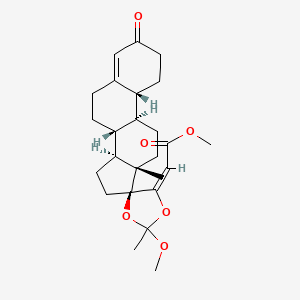
PubChem lists the compound as YK-11 (CID 119058028) with the FDA UNII Z9748J6B0R, the InChIKey KCQHQCDHFVGNMK-PQUNLUOYSA-N and six defined stereocenters. Note that PubChem links the CAS number 1370003-76-1 to several records, so the CID and InChIKey are the cleaner identity checks.
Is YK-11 a steroid or a SARM?
Both labels get used, and both have a point. Structurally, YK-11 is a steroid. Functionally, the Kanno group described it as a selective androgen receptor modulator because it activated the receptor only partially and in a gene-selective way (Kanno et al., Biol Pharm Bull 2011). Most SARMs, such as ostarine (MK-2866), are nonsteroidal, so the plain description is “a steroidal SARM” or “a steroidal androgen receptor partial agonist.” It is not a peptide.
How does YK-11 work? Partial agonism, step by step
The first characterization, published in 2011, used reporter-gene and interaction assays in cultured cells (Kanno et al., Biol Pharm Bull 2011):
- Binding and translocation. YK-11 binds the androgen receptor and speeds up the receptor’s move into the nucleus.
- No N/C interaction. When natural androgens bind, the receptor’s amino-terminal and carboxyl-terminal ends fold together (the “N/C interaction”). YK-11 did not induce that interaction, and it blocked the interaction normally induced by 5α-dihydrotestosterone (DHT).
- Partial activation. In an androgen response element luciferase assay, YK-11 behaved as a partial agonist, which the authors linked to the missing N/C interaction.
- Gene selectivity. In MDA-MB 453 cells, YK-11’s effect relative to an androgen agonist varied by gene.
A 2022 follow-up in the same cell line found different patterns of receptor recruitment to target-gene enhancers for YK-11 versus DHT, and docking suggested YK-11’s bulky C17 group shifts helices 11 and 12 of the receptor (Kanno et al., Exp Cell Res 2022).
What do the cell-model studies show?
The table summarizes the in vitro findings reported by the Kanno laboratory and identity data from PubChem.
| Item | Finding or value | Source |
|---|---|---|
| ARE-luciferase reporter | Partial agonist | Kanno 2011 |
| AR N/C interaction | Not induced; DHT-induced interaction prevented | Kanno 2011 |
| C2C12 myoblasts | MyoD, Myf5 and myogenin induced more than with DHT; follistatin induced | Kanno 2013 |
| MC3T3-E1 osteoblasts | Proliferation and mineralization accelerated; Akt phosphorylation increased | Yatsu 2018 |
| MDA-MB 453 cells | Distinct enhancer recruitment vs. DHT | Kanno 2022 |
| Molecular formula | C25H34O6 | PubChem |
| Molecular weight | 430.5 g/mol | PubChem |
| Exact mass | 430.2355 Da | PubChem |
| XLogP3 | 3.1 | PubChem |
| Defined stereocenters | 6 | PubChem |
What this tells us: the best-known YK-11 finding is the follistatin link. In C2C12 myoblasts, YK-11, but not DHT, induced follistatin, and blocking follistatin with an antibody reversed YK-11’s effect on myogenic differentiation (Kanno et al., Biol Pharm Bull 2013). That is where the frequent “myostatin inhibitor” description comes from. It is an interpretation of a cell-culture result, since follistatin is a known myostatin-binding protein; the paper itself measured follistatin, not direct myostatin inhibition. The osteoblast work found the YK-11 effects were reduced by an androgen receptor antagonist (Yatsu et al., Biol Pharm Bull 2018).
Why the orthoester matters for handling and analysis
Analytical chemists studying YK-11 describe its orthoester-derived D-ring group as arguably labile, meaning it is expected to break down relatively easily (Piper et al., Drug Test Anal 2018). In practical terms, that is a reason to rely on a current, lot-specific COA and to treat solution stability as something to confirm rather than assume.
How is YK-11 tested?
All applicable tests are performed on our products, and the certificates are posted publicly. Open the current YK-11 certificate of analysis to review lot results.
What formats is YK-11 supplied in for research?
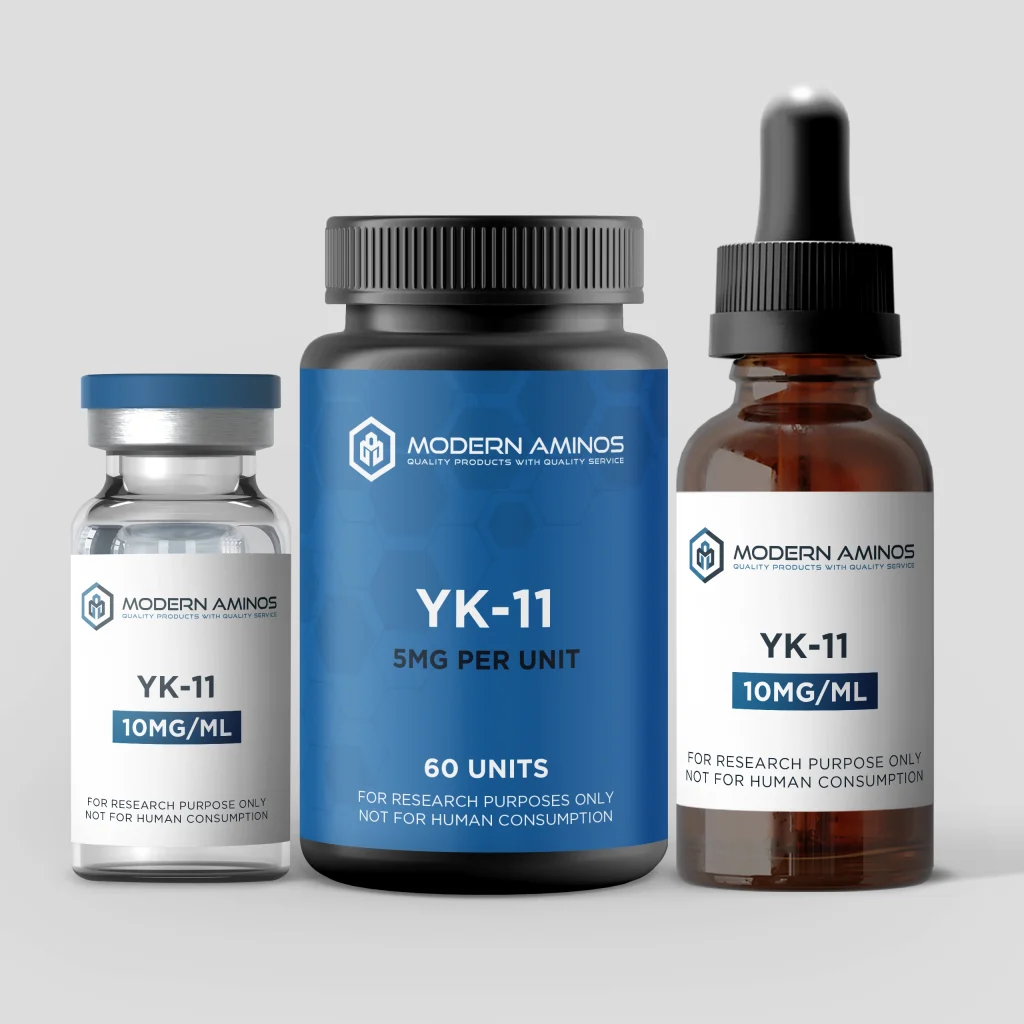
Modern Aminos lists YK-11 in dry-fill capsule, liquid and oil research formats. The liquid and oil formats are what searches for “injectable YK-11” usually refer to, but every format is a laboratory reference material, not a product for injection or any in vivo use. See the YK-11 product page for current formats and availability.
Where YK-11 sits among other androgen receptor research tools
YK-11 is the steroidal outlier in a mostly nonsteroidal class. Compare it with the aryl-propionamide ostarine and the oxadiazole ester RAD-150. For a receptor-independent metabolic tool, see what BAM15 is.
Frequently asked questions
What is YK-11?
YK-11 is a synthetic steroid (CAS 1370003-76-1, C25H34O6, 430.5 g/mol) that acts as a partial agonist of the androgen receptor in cell-based assays. It is supplied for laboratory research use only.
Is YK-11 a steroid or a SARM?
Structurally it is a steroid. It was described as a selective androgen receptor modulator because it activates the receptor partially and gene-selectively in cell assays.
Is YK-11 a myostatin inhibitor?
Not directly, based on the published data. In C2C12 myoblasts YK-11 induced follistatin, a myostatin-binding protein, and blocking follistatin reversed its effect on differentiation.
Is there an injectable YK-11?
Modern Aminos supplies YK-11 in liquid and oil research formats, but no format is intended for injection or any in vivo use. All formats are laboratory reference materials.
How is YK-11 purity verified?
All applicable tests are performed on our products, and the current YK-11 certificate of analysis is posted publicly on the Modern Aminos COA page.
Where can I find YK-11 for sale for research?
Modern Aminos lists YK-11 on its product page in capsule, liquid and oil research formats, for laboratory research use only.
References
- Kanno Y, Hikosaka R, Zhang SY, et al. (17α,20E)-17,20-[(1-methoxyethylidene)bis(oxy)]-3-oxo-19-norpregna-4,20-diene-21-carboxylic acid methyl ester (YK11) is a partial agonist of the androgen receptor. Biol Pharm Bull. 2011;34(3):318-323. doi:10.1248/bpb.34.318 (PMID 21372378)
- Kanno Y, Ota R, Someya K, Kusakabe T, Kato K, Inouye Y. Selective androgen receptor modulator, YK11, regulates myogenic differentiation of C2C12 myoblasts by follistatin expression. Biol Pharm Bull. 2013;36(9):1460-1465. doi:10.1248/bpb.b13-00231 (PMID 23995658)
- Yatsu T, Kusakabe T, Kato K, Inouye Y, Nemoto K, Kanno Y. Selective androgen receptor modulator, YK11, up-regulates osteoblastic proliferation and differentiation in MC3T3-E1 cells. Biol Pharm Bull. 2018;41(3):394-398. doi:10.1248/bpb.b17-00748 (PMID 29491216)
- Kanno Y, Saito N, Saito R, et al. Differential DNA-binding and cofactor recruitment are possible determinants of the synthetic steroid YK11-dependent gene expression by androgen receptor in breast cancer MDA-MB 453 cells. Exp Cell Res. 2022;419(2):113333. doi:10.1016/j.yexcr.2022.113333 (PMID 36030969)
- Piper T, Dib J, Putz M, et al. Studies on the in vivo metabolism of the SARM YK11: identification and characterization of metabolites potentially useful for doping controls. Drug Test Anal. 2018;10(11-12):1646-1656. doi:10.1002/dta.2527 (PMID 30379415)
- National Center for Biotechnology Information. PubChem Compound Summary for CID 119058028, YK-11. pubchem.ncbi.nlm.nih.gov/compound/119058028
YK-11 is a steroid that behaves like a partial, gene-selective androgen receptor agonist in cell models, with a follistatin finding that explains much of the interest in it. Check identity by CID and InChIKey, and rely on a current COA.