
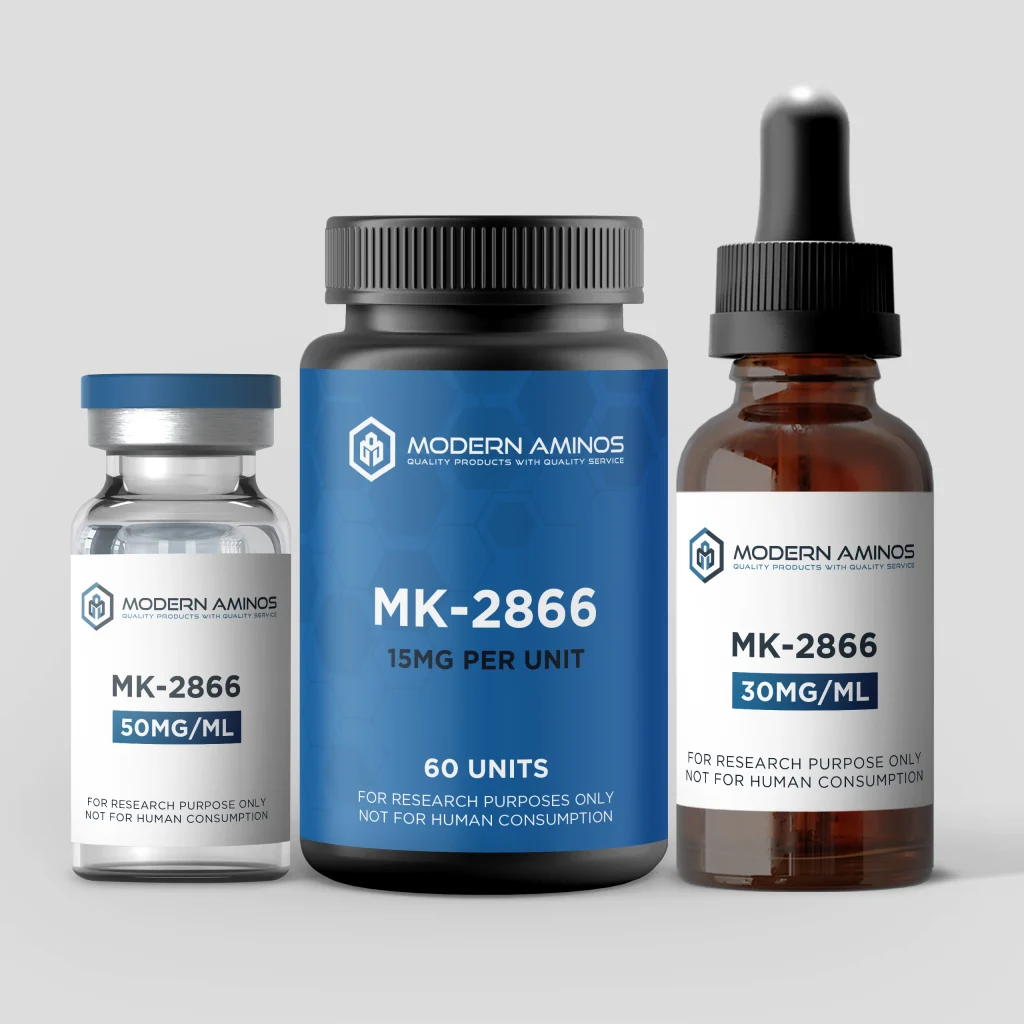
What Is Ostarine?
Short answer: Ostarine is the common name for MK-2866, also called enobosarm (CAS 841205-47-8). It is a nonsteroidal selective androgen receptor modulator (SARM) from the aryl-propionamide class, with the formula C19H14F3N3O3 and a molecular weight of 389.3 g/mol. In the paper that characterized it as compound S-22, it bound the androgen receptor with nanomolar affinity. To buy ostarine (MK-2866) as a documented reference compound, see the product page.
That is the headline. Below is the longer version: how the molecule is built, how it was discovered, what the binding data actually say, and how it is checked.
What is ostarine, chemically speaking?
Ostarine is built like a two-armed propionamide. In the middle sits a three-carbon chain with a hydroxyl group and a methyl group on the same carbon, the carbon that makes the molecule chiral. One arm is an amide linking to a benzene ring carrying a cyano group (–C≡N) and a trifluoromethyl group (–CF3). The other arm is an ether linking to a second benzene ring with its own cyano group (PubChem CID 11326715).
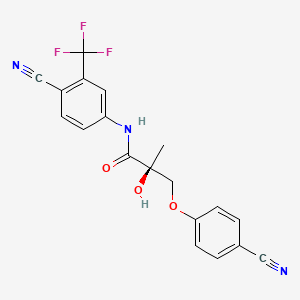
The systematic name is (2S)-3-(4-cyanophenoxy)-N-[4-cyano-3-(trifluoromethyl)phenyl]-2-hydroxy-2-methylpropanamide, and the InChIKey is JNGVJMBLXIUVRD-SFHVURJKSA-N. The “(2S)” matters. The molecule has one defined stereocenter, and the S form is the one described in the literature. PubChem records the synonyms ostarine, enobosarm, MK-2866 and MK2866, and the FDA UNII O3571H3R8N.
Is ostarine a steroid?
No. This is where the “selective” in SARM comes from. Steroidal androgens are built on a four-ring steroid skeleton. Ostarine has no steroid rings at all. It is a flexible, open-chain molecule that still fits the androgen receptor’s ligand pocket. Narayanan and colleagues review SARMs as nonsteroidal agents that bind the androgen receptor, in contrast to testosterone and other steroidal androgens, and summarize crystallography of the receptor bound to these ligands (Narayanan et al., Nucl Recept Signal 2008). It is also not a peptide: there are no amino acids in the structure.
How does ostarine work? Androgen receptor binding, step by step
- Binding. Ostarine enters the cell and binds the ligand-binding domain of the androgen receptor (AR).
- Conformational change. Binding shifts the receptor’s shape, which determines which coregulator proteins it recruits.
- Nuclear action. The ligand-bound receptor moves to the nucleus and binds androgen response elements on DNA.
- Tissue-dependent output. Because coregulator availability differs between cell types, the same ligand can produce different transcriptional outputs. That is the working idea behind tissue selectivity (Narayanan et al., Nucl Recept Signal 2008).
What do the binding data show?
The key primary paper is a 2005 study from the Dalton laboratory that compared four closely related propionamides, named S-19, S-20, S-21 and S-22 (Kim et al., J Pharmacol Exp Ther 2005). S-22 is the compound with a 4-cyanophenoxy group on one side and a 4-cyano-3-(trifluoromethyl)phenyl amide on the other, which matches ostarine’s structure. The table summarizes what that paper and PubChem report.
| Item | Value | Source |
|---|---|---|
| AR binding, S-19 to S-22 series | Ki 2.0–3.8 nM | Kim 2005 |
| Para substituents (S-22) | 4-cyano (phenoxy ring) and 4-cyano (anilide ring) | Kim 2005 |
| Molecular formula | C19H14F3N3O3 | PubChem |
| Molecular weight | 389.3 g/mol | PubChem |
| Exact mass | 389.0987 Da | PubChem |
| XLogP3 | 2.7 | PubChem |
| Topological polar surface area | 106 Å2 | PubChem |
| H-bond donors / acceptors | 2 / 8 | PubChem |
| Defined stereocenters | 1 (S) | PubChem |
What this tells us: all four compounds bound the androgen receptor tightly, within a narrow nanomolar range. The paper’s broader point was that binding affinity measured in vitro did not, on its own, predict how the compounds ranked against each other, and that the para substituent (cyano versus nitro) was a major structural variable across the series (Kim et al., J Pharmacol Exp Ther 2005).
Ostarine vs. cardarine: what is the actual difference?
These two are often listed together, but they work on different receptors. Ostarine binds the androgen receptor. Cardarine (GW-501516) binds PPARδ, a lipid-sensing receptor, and is not a SARM at all. For a steroidal androgen receptor ligand that behaves differently again, see what YK-11 is.
Ostarine, MK-2866, enobosarm, GTx-024, S-22: one compound
PubChem lists all of these as synonyms of one record: S-22 is the series label used in the 2005 paper, GTx-024 is a development code, enobosarm is the USAN/INN name, and MK-2866 and ostarine are the names most often seen in search (PubChem CID 11326715). Searches mix them freely, as in “ostarine mk-2866”, but the CAS number 841205-47-8 and the InChIKey above are the reliable identity checks.
Why does ostarine’s stereocenter matter?
A stereocenter is a carbon with four different groups attached, which means the molecule can exist as two mirror-image forms, like a left and a right hand. Ostarine is defined as the (2S) form, and PubChem records one defined stereocenter for it. The 2005 paper names the whole series as S-configured propionamides, right in its title (Kim et al., J Pharmacol Exp Ther 2005). For a reference material, that makes chiral identity part of the specification: a sample of the wrong hand, or a mix of both, would not match the compound described in the literature.
How is ostarine tested?
All applicable tests are performed on our products, and certificates of analysis are posted publicly. Open the current MK-2866 (ostarine) certificate of analysis to see the lot results. Because ostarine has a stereocenter, a COA that confirms identity against the (2S) structure is worth checking alongside purity.
What formats is ostarine supplied in for research?
Modern Aminos lists MK-2866 in dry-fill capsule, liquid and oil research formats. See the MK-2866 (ostarine) product page for current formats and availability. All formats are laboratory reference materials only.
Where ostarine sits among other androgen receptor research tools
Ostarine is the classic aryl-propionamide reference. For an oxadiazole-based ligand and its ester, read what RAD-150 is. For a steroidal partial agonist with a very different binding story, see our YK-11 explainer. For a non-receptor small-molecule reference, see our DADA explainer.
Frequently asked questions
What is ostarine?
Ostarine is MK-2866, also called enobosarm (CAS 841205-47-8), a nonsteroidal aryl-propionamide selective androgen receptor modulator with the formula C19H14F3N3O3 and a molecular weight of 389.3 g/mol. It is supplied for laboratory research use only.
Is ostarine a steroid?
No. Ostarine has no steroid ring system. It is an open-chain propionamide that binds the androgen receptor without a steroid skeleton.
Are ostarine, MK-2866 and enobosarm the same compound?
Yes. S-22, GTx-024, enobosarm, MK-2866 and ostarine all refer to the same (2S) structure, confirmed by CAS 841205-47-8.
How strongly does ostarine bind the androgen receptor?
In a 2005 study of four related propionamides including S-22, androgen receptor binding constants ranged from 2.0 to 3.8 nM.
How is MK-2866 purity verified?
All applicable tests are performed on our products, and the current MK-2866 certificate of analysis is posted publicly on the Modern Aminos COA page.
Where can I find ostarine for sale for research?
Modern Aminos lists MK-2866 (ostarine) on its product page in capsule, liquid and oil research formats, for laboratory research use only.
References
- Kim J, Wu D, Hwang DJ, Miller DD, Dalton JT. The para substituent of S-3-(phenoxy)-2-hydroxy-2-methyl-N-(4-nitro-3-trifluoromethyl-phenyl)-propionamides is a major structural determinant of in vivo disposition and activity of selective androgen receptor modulators. J Pharmacol Exp Ther. 2005;315(1):230-239. doi:10.1124/jpet.105.088344 (PMID 15987833)
- Narayanan R, Mohler ML, Bohl CE, Miller DD, Dalton JT. Selective androgen receptor modulators in preclinical and clinical development. Nucl Recept Signal. 2008;6:e010. PMC2602589
- National Center for Biotechnology Information. PubChem Compound Summary for CID 11326715, Enobosarm. pubchem.ncbi.nlm.nih.gov/compound/11326715
Ostarine is one molecule with many names, a single stereocenter and a well-documented binding profile. Use the CAS number to cut through the naming, and check the COA for identity and purity.