
What Is Cardarine?
Short answer: Cardarine is the common name for GW-501516 (CAS 317318-70-0), a synthetic small molecule that switches on one nuclear receptor, peroxisome proliferator-activated receptor delta (PPARδ). It has the formula C21H18F3NO3S2 and a molecular weight of 453.5 g/mol. It is not a SARM and it is not a peptide. To buy cardarine (GW-501516) as a documented reference compound, see the product page.
That is the quick version. The rest of this guide walks through what the molecule is, how researchers found it, what it does in a dish, and why so many people file it under the wrong drug class.
What is cardarine, chemically speaking?
Cardarine is a phenoxyacetic acid. Picture a benzene ring carrying three things: a small methyl group, an oxygen that links to an acetic acid tail (–O–CH2–COOH), and a sulfur bridge. That sulfur reaches across a CH2 group to a thiazole, a five-membered ring holding one sulfur and one nitrogen. The thiazole in turn carries a 4-(trifluoromethyl)phenyl group, the CF3 unit that accounts for the three fluorines in the formula (PubChem CID 9803963).
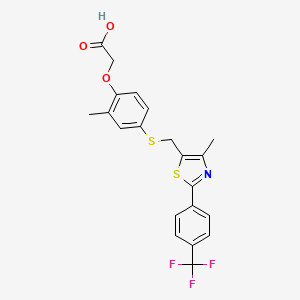
Its systematic name is 2-[2-methyl-4-[[4-methyl-2-[4-(trifluoromethyl)phenyl]-1,3-thiazol-5-yl]methylsulfanyl]phenoxy]acetic acid, and its InChIKey is YDBLKRPLXZNVNB-UHFFFAOYSA-N. PubChem lists the synonyms GW 501516, GW1516, GSK-516 and Endurobol, plus the FDA UNII 7I2HA1NU22 and ChEBI entry CHEBI:73726. The molecule has no stereocenters, so there is only one form to worry about, which keeps identity testing simpler than for chiral compounds.
Is cardarine a SARM?
No. This is the single most common mix-up. SARMs (selective androgen receptor modulators) bind the androgen receptor. Cardarine binds a completely different receptor family, the PPARs, which act as the cell’s sensors for fatty acids and other lipids. The two classes share nothing in structure or target. Cardarine gets lumped in with SARMs mainly because the same catalogs list them side by side, not because of any shared chemistry.
It is not a peptide either. There are no amino acids and no peptide bonds anywhere in the structure. It is a compact, fully synthetic organic acid.
How does cardarine work? PPARδ activation, step by step
GW-501516 was reported in 2001 by a GlaxoSmithKline team that used combinatorial chemistry and structure-based drug design to make a potent, subtype-selective PPARδ agonist (Oliver et al., PNAS 2001). Here is the mechanism in plain terms:
- Entry. The molecule crosses the cell membrane and reaches PPARδ, which sits in the nucleus.
- Binding. It fits into the receptor’s ligand-binding pocket. The carboxylic acid head and the lipophilic tail mimic the shape of a fatty acid, which is the receptor’s natural kind of ligand.
- Partnering. Activated PPARδ pairs with the retinoid X receptor (RXR) and binds specific DNA response elements.
- Transcription. The complex turns on target genes involved in lipid handling.
In the 2001 paper, GW-501516 increased expression of the cholesterol transporter ATP-binding cassette A1 (ABCA1) in macrophages, fibroblasts and intestinal cells, and induced apolipoprotein A1-specific cholesterol efflux (Oliver et al., PNAS 2001). Those are cell-culture readouts, and they are why the compound became a standard tool for studying PPARδ signaling in the lab.
Where cardarine sits in the PPAR family
There are three PPAR subtypes. The table below summarizes how each is described in the 2001 report, which framed GW-501516 as the selective ligand the delta subtype had been missing (Oliver et al., PNAS 2001).
| Item | Detail | Source |
|---|---|---|
| PPARα (NR1C1) | Target of the fibrate drug class | Oliver 2001 |
| PPARγ (NR1C3) | Target of the glitazone drug class | Oliver 2001 |
| PPARδ (NR1C2) | Target of GW-501516 (subtype-selective agonist) | Oliver 2001 |
| Molecular formula | C21H18F3NO3S2 | PubChem |
| Molecular weight | 453.5 g/mol | PubChem |
| Exact mass | 453.0680 Da | PubChem |
| XLogP3 | 5.9 | PubChem |
| Topological polar surface area | 113 Å2 | PubChem |
| H-bond donors / acceptors | 1 / 9 | PubChem |
| Rotatable bonds | 7 | PubChem |
What this tells us: the XLogP of 5.9 marks cardarine as a very lipophilic molecule. In practical lab terms, that is an interpretation worth keeping in mind when choosing solvents and when reading solubility data, since highly lipophilic compounds tend to need organic co-solvents in assay work.
Cardarine vs. SARMs: what is the actual difference?
Put cardarine next to a SARM such as ostarine (MK-2866) and the contrast is clear. Ostarine is an aryl-propionamide built to bind the androgen receptor. Cardarine is a thiazole-linked phenoxyacetic acid built to bind PPARδ. Different receptor, different gene programs, different chemistry. If a research question is about androgen receptor signaling, cardarine is the wrong tool. If it is about lipid-sensing nuclear receptors, it is one of the best-characterized selective ligands available.
Why so many names? GW-501516, GW1516 and Endurobol
GW501516 is the code used in the 2001 paper that first described the compound (Oliver et al., PNAS 2001), and GW1516 is the shortened form used in the analytical literature (Thevis et al., 2013). GSK-516 also appears in PubChem’s synonym list; reading the prefixes as company codes is our interpretation rather than something the sources state. “Cardarine” and “Endurobol” are informal trade names that appear in PubChem’s synonym list but not in the primary literature. You will also see typos such as “GW 50156” in searches. They all point to the same structure, and the reliable way to confirm identity is the CAS number 317318-70-0 or the InChIKey above.
How is cardarine tested?
All applicable tests are performed on our products, and each lot’s certificate of analysis is posted publicly. You can open the current GW-501516 certificate of analysis directly. For context on the analytical chemistry, the sports-testing literature has published a full mass spectrometric characterization of GW-501516 and its major metabolites, which is a useful reference when setting up LC-MS identity methods (Thevis et al., 2013).
What formats is cardarine supplied in for research?
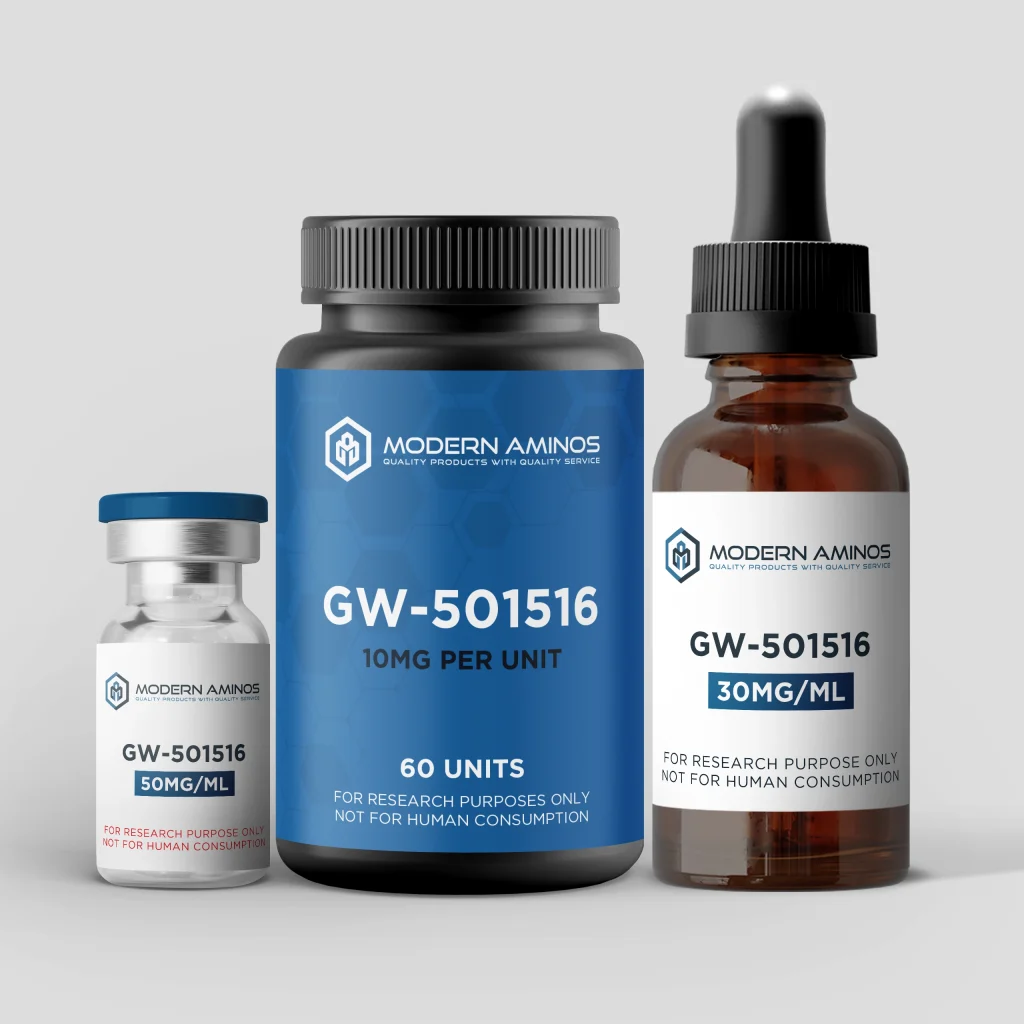
Modern Aminos lists GW-501516 in dry-fill capsule, liquid and oil research formats. See the GW-501516 product page for current formats and availability. Every format is sold strictly as laboratory reference material.
Where cardarine sits among other metabolic research tools
Cardarine is often studied alongside other nuclear-receptor and mitochondrial tools. For a compound that works at the mitochondria instead of the nucleus, read what BAM15 is. For a contrasting androgen receptor ligand, see what RAD-150 is, and for a small-molecule metabolic reference outside the receptor world, see our DADA explainer.
Frequently asked questions
What is cardarine?
Cardarine is GW-501516 (CAS 317318-70-0), a synthetic small-molecule agonist of the nuclear receptor PPARδ. It has the formula C21H18F3NO3S2 and a molecular weight of 453.5 g/mol, and it is supplied for laboratory research use only.
Is cardarine a SARM?
No. SARMs bind the androgen receptor, while cardarine binds PPARδ, a lipid-sensing nuclear receptor. The two classes share no target and no core structure.
Is cardarine a peptide?
No. GW-501516 contains no amino acids or peptide bonds. It is a thiazole-linked phenoxyacetic acid.
Are GW-501516, GW1516 and cardarine the same compound?
Yes. GW-501516 and GW1516 are research codes, and cardarine and Endurobol are informal names for the same structure, confirmed by CAS 317318-70-0.
How is GW-501516 purity verified?
All applicable tests are performed on our products, and the current GW-501516 certificate of analysis is posted publicly on the Modern Aminos COA page.
Where can I find cardarine for sale for research?
Modern Aminos lists GW-501516 on its product page in capsule, liquid and oil research formats, for laboratory research use only.
References
- Oliver WR Jr, Shenk JL, Snaith MR, et al. A selective peroxisome proliferator-activated receptor delta agonist promotes reverse cholesterol transport. Proc Natl Acad Sci U S A. 2001;98(9):5306-5311. doi:10.1073/pnas.091021198 (PMID 11309497)
- Thevis M, Möller I, Beuck S, Schänzer W. Synthesis, mass spectrometric characterization, and analysis of the PPARδ agonist GW1516 and its major human metabolites: targets in sports drug testing. Methods Mol Biol. 2013;952:301-312. doi:10.1007/978-1-62703-155-4_22 (PMID 23100242)
- National Center for Biotechnology Information. PubChem Compound Summary for CID 9803963, GW 501516. pubchem.ncbi.nlm.nih.gov/compound/9803963
Cardarine is best understood as what it is: a selective PPARδ agonist with a well-defined structure and a long record as a laboratory tool. Keep the identifiers handy, check the COA, and treat the nicknames as nicknames.