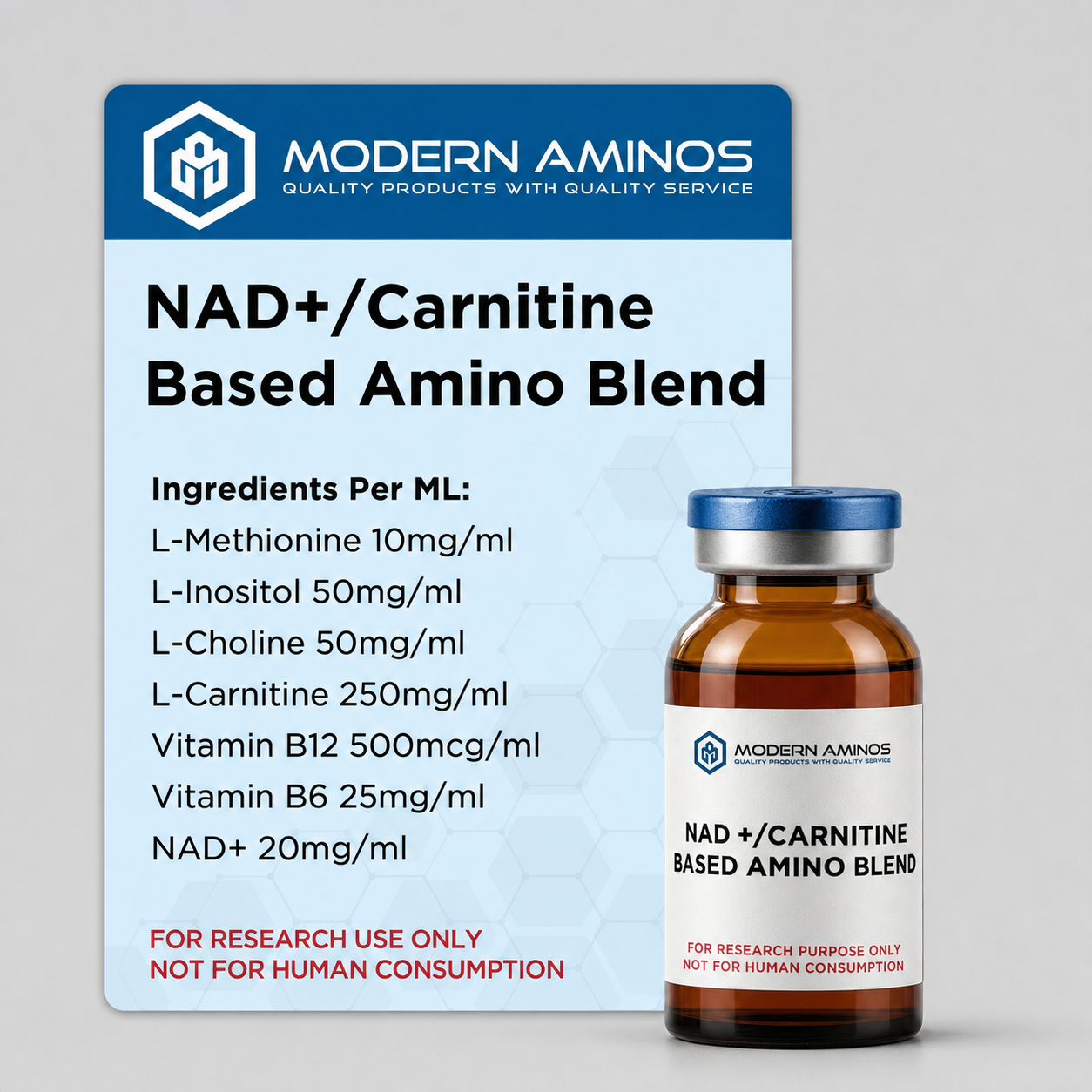
The NAD+ / Carnitine Based Amino Blend (20ML Glass Vial) is a high-potency multi-pathway metabolic formulation combining NAD+ (20 mg/mL) and L-Carnitine (250 mg/mL) with lipotropic and methyl-donor cofactors—Methylcobalamin B12 (500 mcg/mL), L-Methionine (10 mg/mL), L-Inositol (50 mg/mL), L-Choline Bitratrate (50 mg/mL), and Pyridoxine B6 (25 mg/mL)—in a stabilized vehicle containing 1.5% Lidocaine and 0.9% Benzyl Alcohol. Engineered to investigate coupled mitochondrial electron transport, beta-oxidation kinetics, and Kennedy pathway phospholipid membrane biogenesis,
This must be stored below 7C (45F) to prevent accelerated degradation of the NAD+ coenzyme.
Original price was: $64.00.$44.80Current price is: $44.80.
In stock
| Quantity | Discounted Price |
|---|---|
| 4 - 6 | $61.44 |
| 7 - 9 | $60.16 |
| 10 + | $58.88 |
The NAD+ / Carnitine Based Amino Blend is a concentrated, multi-component liquid analytical standard combining seven biologically coordinated metabolic catalysts, methyl-group donors, and mitochondrial cofactors in a stable 20ML amber glass vial.
Engineered to evaluate converging bioenergetic and lipid clearance cascades, this matrix integrates high-potency synergistic complex of lipotropic amino derivatives and active B-vitamins:
Together, these constituents allow laboratory investigators to simultaneously probe mitochondrial oxidative phosphorylation (Complex I electron transfer), carnitine palmitoyltransferase-mediated fatty acid shuttle mechanisms (CPT-1/CPT-2), one-carbon homocysteine remethylation, and Kennedy pathway phospholipid membrane biogenesis.
Batch-verified for exact quantitative concentration and chromatographic purity at Modern Aminos, this 7-in-1 liquid solution is supplied in a light-protective 20ML amber vial. Researchers evaluate this multi-pathway standard alongside complementary bioenergetic and longevity reference compounds available on the site, such as standalone NAD+, L-Carnitine 600mg/mL, S-Acetyl-L-Glutathione, SLU-PP-332, and BAM15.
| Active Constituent | Concentration (per mL) | Total Content (20ML Vial) | Primary Molecular Mechanism |
|---|---|---|---|
| NAD+ (β-Nicotinamide Adenine Dinucleotide) | 20 mg/mL | 400 mg | Mitochondrial Complex I Electron Transfer & Sirtuin/PARP Co-Substrate |
| L-Carnitine Base | 250 mg/mL | 5,000 mg | CPT-1/CPT-2 Mitochondrial Long-Chain Fatty Acid Shuttle & CRAT Buffering |
| Methylcobalamin (Vitamin B12) | 500 mcg/mL (0.5 mg/mL) | 10,000 mcg (10 mg) | Methionine Synthase Cofactor & One-Carbon Homocysteine Remethylation |
| L-Methionine | 10 mg/mL | 200 mg | S-Adenosylmethionine (SAMe) Precursor & Transsulfuration Substrate |
| L-Inositol (Myo-Inositol) | 50 mg/mL | 1,000 mg | Phosphatidylinositol Precursor & IP3 Calcium Signaling Architecture |
| L-Choline Bitartrate | 50 mg/mL | 1,000 mg | Kennedy Pathway Phosphatidylcholine Synthesis & Acetylcholine Precursor |
| Pyridoxine HCl (Vitamin B6) | 25 mg/mL | 500 mg | PLP Coenzyme for Amino Acid Transamination & Cystathionine β-Synthase |
The synergistic biochemical pathways and cellular targets of the NAD+ / Carnitine Based Amino Blend in laboratory research include:
When evaluating research efficacy and published scientific literature for the active components of this formulation:
To evaluate multi-pathway synergy versus single-target pathways, researchers compare the NAD+ / Carnitine Based Amino Blend against standalone metabolic reference standards available at Modern Aminos:
| Formulation / Reference | Active Composition | Primary Mechanistic Focus | Research Profile |
|---|---|---|---|
| NAD+ / Carnitine Amino Blend | NAD+ + L-Carnitine + B12 + Methionine + Inositol + L-Choline Bitartrate + B6 | Simultaneous β-Oxidation, Complex I Respiration, SAMe Methylation, & Phospholipid Synthesis | Comprehensive multi-target bioenergetics, mitochondrial respiration assays, and multi-cofactor flux modeling |
| Standalone NAD+ | Pure β-Nicotinamide Adenine Dinucleotide | Hydride Acceptance (NADH) & Sirtuin/PARP Enzymatic Cleavage | Isolated sirtuin deacetylation kinetics, PARP1 DNA repair, and direct redox potential studies |
| Standalone L-Carnitine | Pure L-Carnitine Base (600mg/mL) | CPT-1/CPT-2 Mitochondrial Fatty Acid Catalyst & CRAT Buffering | High-density fatty acid transport kinetics, bioenergetic, and acetyl-CoA ratio modulation |
| Classic MIC Blend | L-Methionine + L-Inositol + Choline | Hepatic Triacylglycerol Mobilization & Phosphatidylcholine Synthesis | Lipotropic lipid export, hepatic adipose accumulation models, and basic one-carbon donor assays |
Yes, Modern Aminos is a highly trusted vendor for high-purity research chemicals and complex analytical formulations. Every batch of the NAD+ / Carnitine Based Amino Blend undergoes strict third-party testing (including HPLC and Mass Spectrometry) to verify exact concentration values for all seven constituents, correct pH balance, chromatographic stability, and complete absence of heavy metals or microbial contaminants.
This 20ML liquid analytical standard contains NAD+ (20 mg/mL), L-Carnitine (250 mg/mL), Methylcobalamin B12 (500 mcg/mL), L-Methionine (10 mg/mL), L-Inositol (50 mg/mL), L-Choline Bitartrate (50 mg/mL), and Pyridoxine B6 (25 mg/mL) pre-solubilized in an aqueous buffer.
L-Carnitine transports long-chain fatty acids into the mitochondria for beta-oxidation. Beta-oxidation generates reducing equivalents that convert NAD+ to NADH. NADH then feeds electrons directly into Complex I of the respiratory chain to generate ATP, coupling fuel transport directly to oxidative phosphorylation.
Methionine provides sulfur-donor methyl groups via SAMe, Inositol supports membrane phosphatidylinositol signaling and insulin sensitivity pathways, and L-Choline Bitartrate provides rate-limiting phosphocholine for membrane phospholipid repair, preventing intracellular lipid accumulation.
Methylcobalamin is the active methyl-donor coenzyme required to remethylate homocysteine back to methionine, while Pyridoxine (as PLP) acts as an essential cofactor for transamination and the transsulfuration pathway converting homocysteine to glutathione (GSH).
Standalone compounds evaluate isolated enzymatic kinetics. This 7-in-1 formulation allows researchers to model complete, multi-step metabolic systems where fatty acid mobilization, mitochondrial electron transport, and methyl-group replenishment operate in continuous equilibrium.
Modern Aminos uses multi-channel High-Performance Liquid Chromatography (HPLC) and Mass Spectrometry (MS) to resolve, identify, and quantify each active peak against authenticated reference standards prior to releasing each finished vial batch.
The 20ML amber glass vial should be stored tightly sealed under refrigerated conditions (2°C to 8°C) and protected from direct light exposure to preserve the chemical stability of NAD+ and Methylcobalamin in aqueous solution.
Disclaimer: All compounds and research materials provided by Modern Aminos are strictly for laboratory and research professional use only. They are not approved for human or animal use nor consumption by the Food and Drug Administration (FDA). These products should not be used for any form of in vivo experimentation or for any other non-laboratory purpose. Any violation or indication of human or animal use will result in immediate removal from being able to purchase products in the future. By purchasing these products, you acknowledge that they will be used exclusively within a controlled and qualified research environment.
The products offered by Modern Aminos are intended strictly for laboratory research purposes only and are sold exclusively to qualified professionals, institutions, and entities. These products are not for human consumption, veterinary use, or any other application involving living organisms, including but not limited to diagnostic, therapeutic, or recreational purposes.
By purchasing this product, you confirm that:
Modern Aminos does not claim that this product is approved by the U.S. Food and Drug Administration (FDA) for any purpose. The statements regarding this product have not been evaluated by the FDA. This product is not intended to diagnose, treat, cure, or prevent any disease.
The buyer assumes full responsibility for ensuring the safe handling, storage, and use of this product. Modern Aminos is not liable for any damages, direct or indirect, resulting from improper handling, storage, or unauthorized use of this product. Furthermore, Modern Aminos reserves the right to refuse sales to any individual or entity suspected of misusing its products.
If you have questions about the safe and lawful use of this product, consult a qualified professional with expertise in laboratory research. By proceeding with this purchase, you agree to these terms and conditions.
